
Receptors

Receptors

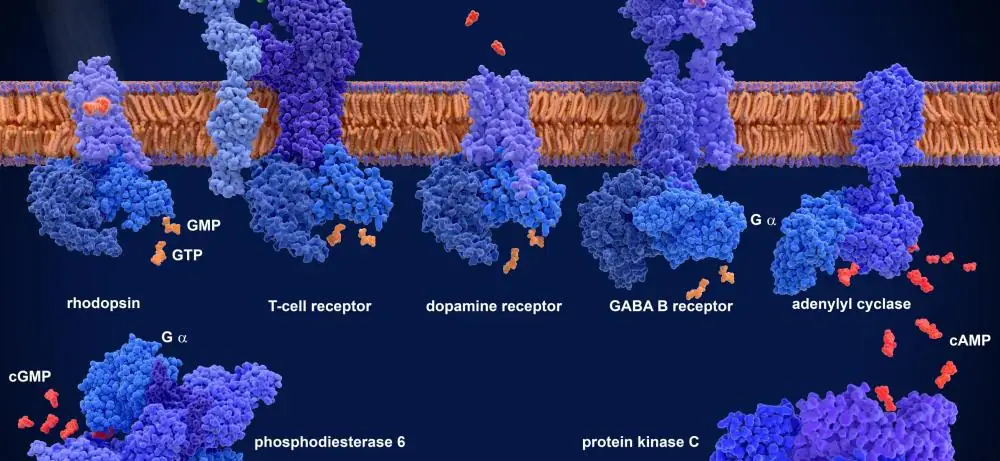
All cells in a multicellular organism are constantly exposed to a variety of extracellular signals that they need to interpret and translate into an appropriate response to their environment. These signals can be soluble factors generated locally (for example, synaptic transmission) or distantly (for example, hormones and growth factors), ligands on the surface of other cells, or the extracellular matrix itself. To achieve this, cells maintain a diversity of receptors on their surface that respond specifically to individual stimuli. These receptors fall into families, based primarily on the way in which they generate the intracellular signals that give rise to the particular functional responses. Moreover, the activity of a given receptor can be modulated by other signaling pathways in a variety of ways, generating the flexibility required of such a complex system. Axon Ligands™ that target receptors are categorized based on the major classification proposed by the IUPAC, including G-protein coupled receptors (GPCRs), enzyme linked receptors, nuclear receptors, sigma receptors, PAQR receptors, cytokine receptors, and a number of unclassified receptors (including integrin, thrombopoietin, and nucleotide-binding oligomerization domain-like (NLR) receptors.

Read More
sort-descending
  • KPT-330
    2336
    The price depends on the options chosen on the product page

    From $99.00

  • KPT 335
    2597
    The price depends on the options chosen on the product page

    From $104.50

  • Ibetazol
    4300
    The price depends on the options chosen on the product page

    From $121.00

3 Items

More About Receptors

All cells in a multicellular organism are constantly exposed to a variety of extracellular signals that they need to interpret and translate into an appropriate response to their environment. These signals can be soluble factors generated locally (for example, synaptic transmission) or distantly (for example, hormones and growth factors), ligands on the surface of other cells, or the extracellular matrix itself. To achieve this, cells maintain a diversity of receptors on their surface that respond specifically to individual stimuli. These receptors fall into families, based primarily on the way in which they generate the intracellular signals that give rise to the particular functional responses. Moreover, the activity of a given receptor can be modulated by other signaling pathways in a variety of ways, generating the flexibility required of such a complex system.  Axon Ligands™ that target receptors are categorized based on the major classification proposed by the IUPAC, incluing G-protein coupled receptors (GPCRs), enzyme linked receptors,  nuclear receptors, sigma receptors, PAQR receptors, cytokine receptors, and a number of unclassified receptors (including integrin, thrombopoietin, and nucleotide-binding oligomerization domain-like (NLR) receptors[1]. [1] I.J. Uings, S.N. Farrow. Cell receptors and cell signaling. Mol. Pathol. 2000, 53, 295-299.
Loading...