
Signaling Pathways

Signaling Pathways

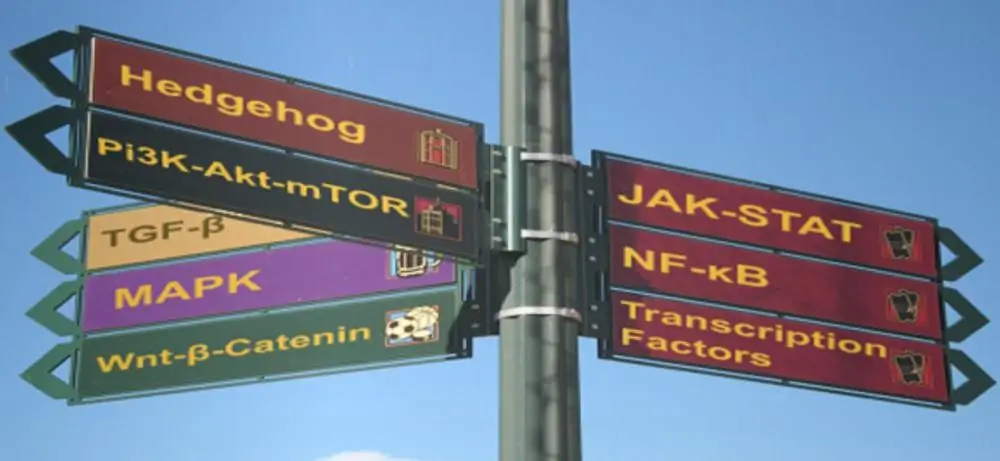
A basic property of living systems is the ability to respond to extracellular signals by evoking an internal response. Signal-transduction cascades mediate the sensing and processing of these stimuli. These molecular circuits detect, amplify, and integrate diverse external signals to generate responses such as changes in enzyme activity, gene expression, phenotypic alterations, or ion-channel activity. Signal-transduction pathways follow a broadly similar course that can be viewed as a molecular circuit. Upon an environmental signal, Membrane receptors transfer information from the environment to the cell's interior. Subsequently, second messengers relay information from the receptor-ligand complex into the cell's interior. Particularly important second messengers include cyclic AMP and cyclic GMP, calcium ion, inositol 1,4,5-trisphosphate, (IP3), and diacylglycerol. While these second messengers are free to move, they can easily diffuse to other compartments of the cell, such as the nucleus, where they can influence gene expression and other processes. Interestingly, signal transduction may be amplified significantly in the generation of second messengers, since initial stimulation may lead to the generation of many second messengers within the cell. Thus, a low concentration of signal in the environment, even as little as a single molecule, can yield a large intracellular signal and response. Besides this phenomenon, cross-talk between two or more signaling cascades may occur, which permits more finely tuned regulation of cell activity than would the action of individual independent pathways

Read More
sort-descending
  • SL 327
    1122
    The price depends on the options chosen on the product page

    From $88.00

  • CHIR98014
    1126
    The price depends on the options chosen on the product page

    From $108.90

  • Erlotinib hydrochloride
    1128
    The price depends on the options chosen on the product page

    From $77.00

  • BX 912
    1130
    The price depends on the options chosen on the product page

    From $88.00

  • PD180970
    1137
    The price depends on the options chosen on the product page

    From $143.00

  • GSK 269962A
    1167
    The price depends on the options chosen on the product page

    From $77.00

  • PD98059
    1223
    The price depends on the options chosen on the product page

    From $88.00

  • Deguelin
    1239
    The price depends on the options chosen on the product page

    From $121.00

  • NSC 625987
    1243
    The price depends on the options chosen on the product page

    From $104.50

  • Necrostatin-1
    1258
    The price depends on the options chosen on the product page

    From $77.00

  • DR 2313
    1268
    The price depends on the options chosen on the product page

    From $99.00

  • BEZ 235
    1281
    The price depends on the options chosen on the product page

    From $55.00

  • BAG 956
    1282
    The price depends on the options chosen on the product page

    From $104.50

  • AEG 3482
    1291
    The price depends on the options chosen on the product page

    From $99.00

  • SB 216763
    1303
    The price depends on the options chosen on the product page

    From $93.50

More About Signaling Pathways

A basic property of living systems is the ability to respond to extracellular signals by evoking an internal response. Signal-transduction cascades mediate the sensing and processing of these stimuli. These molecular circuits detect, amplify, and integrate diverse external signals to generate responses such as changes in enzyme activity, gene expression, phenotypic alterations, or ion-channel activity. Signal-transduction pathways follow a broadly similar course that can be viewed as a molecular circuit. Upon an environmental signal, Membrane receptors transfer information from the environment to the cell's interior. Subsequently, second messengers relay information from the receptor-ligand complex into the cell's interior. Particularly important second messengers include cyclic AMP and cyclic GMP, calcium ion, inositol 1,4,5-trisphosphate, (IP3), and diacylglycerol. While these second messengers are free to move, they can easily diffuse to other compartments of the cell, such as the nucleus, where they can influence gene expression and other processes. Interestingly, signal transduction may be amplified significantly in the generation of second messengers, since initial stimulation may lead to the generation of many second messengers within the cell. Thus, a low concentration of signal in the environment, even as little as a single molecule, can yield a large intracellular signal and response. Besides this phenomenon, cross-talk between two or more signaling cascades may occur, which permits more finely tuned regulation of cell activity than would the action of individual independent pathways[1]


[1] Signal-Transduction Pathways: An Introduction to Information Metabolism. Biochemistry. 5th edition. J.M. Berg, J.L.Tymoczko, L. Stryer.New York, 2002.

Loading...