
BMP-ALK

BMP-ALK

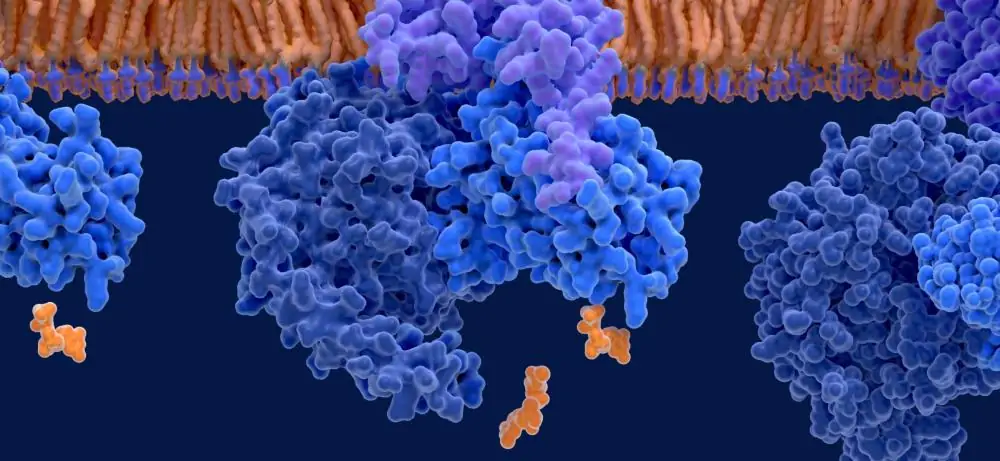
Transforming growth factor-β (TGF-β) family, including TGF-β, activin, Nodal, bone morphogenetic proteins (BMPs) and others, play vital roles in diverse cellular processes, including cell proliferation, differentiation, apoptosis, cell plasticity and migration. The type I receptor serine/threonine kinases (RSTKs) are also known as activin receptor-like kinases (ALKs) for which a systematic nomenclature has been proposed (ALK1-7) Its dysfunctions can result in various kinds of diseases, such as cancer and tissue fibrosis. Ligand binding leads to formation of the receptor heterocomplex, in which TGF-βRII phosphorylates threonine and serine residues of TGF-βRI and thus activates TGF-βRI. The activated TGF-βRI recruits and phosphorylates a subset of SMAD proteins (SMAD 2/3) which are then translocated to the nucleus where they form transcription complexes with DNA binding factors and co-activators/co-repressors to regulate transcription of the target genes. In normal cells, TGF-β, acting through its signaling pathway, stops the cell cycle at the G1 stage to stop proliferation, induce differentiation, or promote apoptosis. When a cell is transformed into a cancer cell, parts of the TGF-β signaling pathway are mutated, and TGF-β no longer controls the cell. These cancer cells proliferate.

Read More
sort-descending
  • LDN 193189 hydrochloride
    1509
    The price depends on the options chosen on the product page

    From $71.50

  • Dorsomorphin
    1708
    The price depends on the options chosen on the product page

    From $71.50

  • Dorsomorphin dihydrochloride
    2150
    The price depends on the options chosen on the product page

    From $71.50

  • K 02288
    2189
    The price depends on the options chosen on the product page

    From $99.00

  • LDN 212854 trihydrochloride
    2201
    The price depends on the options chosen on the product page

    From $121.00

  • SJ000291942
    2903
    The price depends on the options chosen on the product page

    From $104.50

  • LDN 212854
    3552
    The price depends on the options chosen on the product page

    From $121.00

  • CDD-1653
    3914
    The price depends on the options chosen on the product page

    From $121.00

  • SB4
    4165
    The price depends on the options chosen on the product page

    From $88.00

  • DMH-1
    4387
    The price depends on the options chosen on the product page

    From $132.00

  • Stem Cell LSB inhibitor Set
    5004
    The price depends on the options chosen on the product page

    From $99.00

  • Stem Cell LSC inhibitor Set
    5005
    The price depends on the options chosen on the product page

    From $143.00

  • Stem Cell 5i inhibitor Set
    5007
    The price depends on the options chosen on the product page

    From $220.00

13 Items

More About BMP-ALK

Transforming growth factor-β (TGF-β) family, including TGF-β, activin, Nodal, bone morphogenetic proteins (BMPs) and others, play vital roles in diverse cellular processes, including cell proliferation, differentiation, apoptosis, cell plasticity and migration. The type I receptor serine/threonine kinases (RSTKs) are also known as activin receptor-like kinases (ALKs) for which a systematic nomenclature has been proposed (ALK1-7) Its dysfunctions can result in various kinds of diseases, such as cancer and tissue fibrosis. Ligand binding leads to formation of the receptor heterocomplex, in which TGF-βRII phosphorylates threonine and serine residues  of TGF-βRI and thus activates TGF-βRI. The activated TGF-βRI recruits and phosphorylates a subset of SMAD proteins (SMAD 2/3) which are then translocated to the nucleus where they form transcription complexes with DNA binding factors and co-activators/co-repressors to regulate transcription of the target genes[1]. In normal cells, TGF-β, acting through its signaling pathway, stops the cell cycle at the G1 stage to stop proliferation, induce differentiation, or promote apoptosis. When a cell is transformed into a cancer cell, parts of the TGF-β signaling pathway are mutated, and TGF-β no longer controls the cell. These cancer cells proliferate[2].


[1] Regulation of TGF-β receptor activity. F. Huang Y.G. Chen. Cell Biosc. 2012, 2-9.
[2] Mechanisms of TGF-beta signaling from cell membrane to the nucleus. Shi Y, Massagué J. Cell. 2003, 113, 685-700.

Loading...