
RTK

RTK

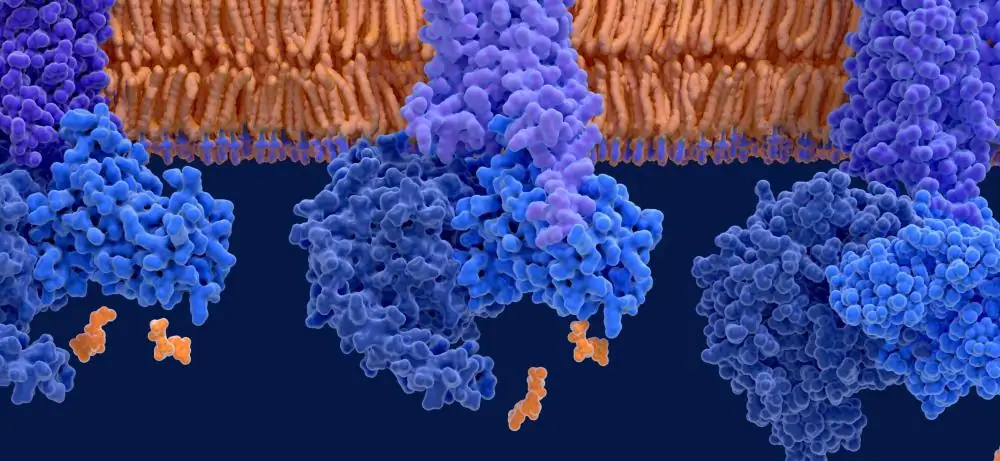
Many of the Axon Ligands™ in this class of compounds target receptors of various growth factors, such as EGF, VEGF, and PDGF. These receptors are members of the class of enzyme linked receptors, which, as integral membrane proteins, possess both receptor functionality (extra-cellular) as well as enzymatic catalytic functionality (intracellular). The majority of the enzymatic activity of this class of receptors is characterized by kinase-like activity. Based on this feature, five main classes can be distinguished: Receptor Tyrosine Kinases (RTKs), and Receptor Serine/Threonine Kinases (RSTKs, participating in MAPK and TGF-beta signaling pathways, among others) are well known. Additionally, there are classes of Receptor Guanylyl Cyclases, Histidine Kinase associated Receptors (receptors that associate with proteins that have histidine kinase activity), and finally a class of Tyrosine Kinase associated Receptors (e.g. Cytokine Receptors). In addition, some transmembrane tyrosine phosphatases (Receptor-like) Protein Tyrosine Phosphatases (PTPs)), which remove phosphate from phosphotyrosine side chains of specific proteins, are thought to function as receptors, although for the most part their ligands are unknown. Within each of these main classes, sub-classes exist, based on the specific endogenous ligands. Many of the enzyme linked receptors play a role in the regulation of cell proliferation, programmed cell death (apoptosis), cell differentiation, and embryonic development, and therefore are of great interest as targets for the treatment of cancer. Furthermore, malfunctioning of receptors of this kind is associated with the development of neurodegenerative diseases, such as multiple sclerosis and Alzheimer's disease.

Read More
sort-descending
  • Erlotinib hydrochloride
    1128
    The price depends on the options chosen on the product page

    From $77.00

  • GW 441756
    1251
    The price depends on the options chosen on the product page

    From $82.50

  • Gefitinib
    1393
    The price depends on the options chosen on the product page

    From $77.00

  • Imatinib mesylate
    1394
    The price depends on the options chosen on the product page

    From $66.00

  • Lapatinib ditosylate
    1395
    The price depends on the options chosen on the product page

    From $88.00

  • Sunitinib malate
    1398
    The price depends on the options chosen on the product page

    From $88.00

  • Vandetanib
    1411
    The price depends on the options chosen on the product page

    From $55.00

  • AG 013736
    1414
    The price depends on the options chosen on the product page

    From $55.00

  • CT 53518
    1415
    The price depends on the options chosen on the product page

    From $77.00

  • NVP-TAE684
    1416
    The price depends on the options chosen on the product page

    From $55.00

  • AB 1010
    1419
    The price depends on the options chosen on the product page

    From $77.00

  • Pazopanib hydrochloride
    1420
    The price depends on the options chosen on the product page

    From $66.00

  • CI 1033
    1433
    The price depends on the options chosen on the product page

    From $66.00

  • Cediranib
    1461
    The price depends on the options chosen on the product page

    From $77.00

  • WZ 4002
    1506
    The price depends on the options chosen on the product page

    From $77.00

More About RTK

Many of the Axon Ligands™ in this class of compounds target receptors of various growth factors, such as EGF, VEGF, and PDGF. These receptors are members of the class of enzyme linked receptors, which, as integral membrane proteins, possess both receptor functionality (extra-cellular) as well as enzymatic catalytic functionality (intracellular)[1],[2]. The majority of the enzymatic activity of this class of receptors is characterized by kinase-like activity. Based on this feature, five main classes can be distinguished[3]: Receptor Tyrosine Kinases (RTKs), and Receptor Serine/Threonine Kinases (RSTKs, participating in MAPK and TGF-beta signaling pathways, among others) are well known. Additionally, there are classes of Receptor Guanylyl Cyclases, Histidine Kinase associated Receptors (receptors that associate with proteins that have histidine kinase activity), and finally a class of Tyrosine Kinase associated Receptors (e.g. Cytokine Receptors). In addition, some transmembrane tyrosine phosphatases (Receptor-like) Protein Tyrosine Phosphatases (PTPs)), which remove phosphate from phosphotyrosine side chains of specific proteins, are thought to function as receptors, although for the most part their ligands are unknown. Within each of these main classes, sub-classes exist, based on the specific endogenous ligands. Many of the enzyme linked receptors play a role in the regulation of cell proliferation, programmed cell death (apoptosis), cell differentiation, and embryonic development, and therefore are of great interest as targets for the treatment of cancer[4]. Furthermore, malfunctioning of receptors of this kind is associated with the development of neurodegenerative diseases, such as multiple sclerosis and Alzheimer's disease[5].


[1] Catalytic Receptors. S.P.H. Alexander, A. Mathie, and J.A. Peters. Br. J. Pharmacol. 2007, 150(S1): S122–S127. 
[2] Cell Signaling by Receptor Tyrosine Kinases. M.A. Lemmon, J. Schlessinger. Cell 2010, 141, 1117-1134.
[3] Molecular Biology of the Cell. 4th edition. Alberts B, Johnson A, Lewis J, et al.New York:Garland Science; 2002.
[4] Tyrosine kinase receptors as attractive targets of cancer therapy. Bennasroune A, Gardin A., Aunis D., Crémel G., Hubert P. Crit. Rev. Oncol. Hematol. 2004, 50, 23-38.
[5] The EGF receptor family: spearheading a merger of signaling and therapeutics. Bublil E.M., Yarden Y. Curr. Opin. Cell Biol. 2007, 19,124-134.

Loading...