
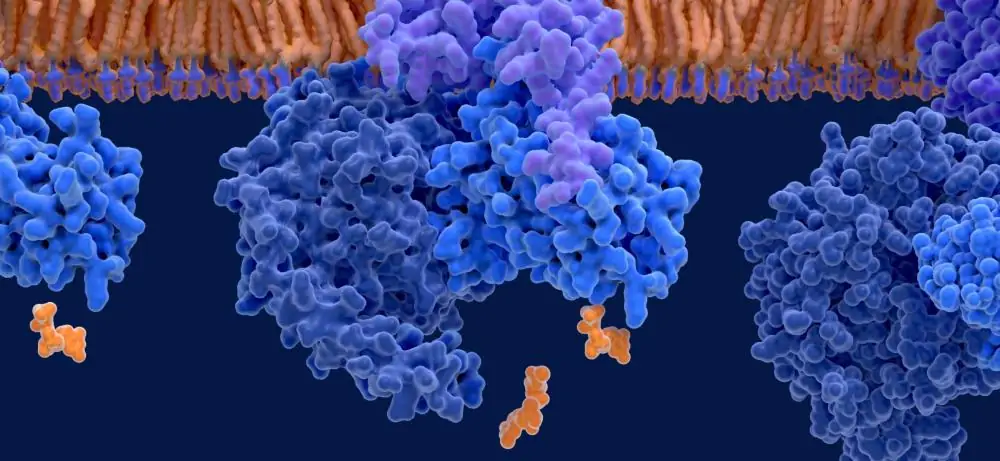
PDGFR

PDGFR

The PDGF family of growth factors consists of five different disulphide-linked dimers built up of four different polypeptide chains encoded by four different genes. These five isoforms act via two receptor tyrosine kinases, PDGF receptors alpha and beta (RTK class III, PDGF receptor family). The PDGFs have a common structure with the typical growth factor domain involved in the dimerization of the two subunits, and in receptor binding and activation. All four PDGF chains contain a highly conserved growth factor domain, denoted the PDGF/VEGF homology domain. Upon activation by their endogenous ligands, these receptors dimerize, and are activated by auto-phosphorylation of several sites on their cytosolic domains, which serve to mediate binding of co-factors and subsequently activate signal transduction, for example, through the PI3K and the MAPK pathways. Both PDGF and VEGF family members are potent mitogenic and angiogenic factors with critical roles in tumor formation as well as embryonic development and wound healing.FLT3 (Fms-liketyrosine kinase 3, aka CD135) is a cytokine receptor which belongs to the class III receptor tyrosine kinase family. It is expressed on the surface of many hematopoietic progenitor cells. Notably, approximately one-third of acute myeloid leukemia (AML) patients have mutations of this gene, and such mutations are one of the most frequently identified types of genetic alterations in AML. The majority of the mutations involve an internal tandem duplication (ITD) in the juxtamembrane (JM) domain of FLT3, which is specifically found in AML.

Read More
sort-descending
  • Imatinib mesylate
    1394
    The price depends on the options chosen on the product page

    From $66.00

  • Sunitinib malate
    1398
    The price depends on the options chosen on the product page

    From $88.00

  • AG 013736
    1414
    The price depends on the options chosen on the product page

    From $55.00

  • CT 53518
    1415
    The price depends on the options chosen on the product page

    From $77.00

  • AB 1010
    1419
    The price depends on the options chosen on the product page

    From $77.00

  • Pazopanib hydrochloride
    1420
    The price depends on the options chosen on the product page

    From $66.00

  • ABT 869
    1638
    The price depends on the options chosen on the product page

    From $88.00

  • AMG 706
    1768
    The price depends on the options chosen on the product page

    From $115.50

  • SU 6668
    1891
    The price depends on the options chosen on the product page

    From $110.00

  • Amuvatinib
    2368
    The price depends on the options chosen on the product page

    From $132.00

  • Nintedanib
    2648
    The price depends on the options chosen on the product page

    From $77.00

  • SU11652
    2767
    The price depends on the options chosen on the product page

    From $154.00

  • Lenvatinib
    3165
    The price depends on the options chosen on the product page

    From $77.00

  • Toceranib phosphate
    3624
    The price depends on the options chosen on the product page

    From $66.00

  • Crenolanib
    3969
    The price depends on the options chosen on the product page

    From Inquiry

15 Items

More About PDGFR

The PDGF family of growth factors consists of five different disulphide-linked dimers built up of four different polypeptide chains encoded by four different genes. These five isoforms act via two receptor tyrosine kinases, PDGF receptors alpha and beta (RTK class III, PDGF receptor family)[1].  The PDGFs have a common structure with the typical growth factor domain involved in the dimerization of the two subunits, and in receptor binding and activation. All four PDGF chains contain a highly conserved growth factor domain, denoted the PDGF/VEGF homology domain[2]. Upon activation by their endogenous ligands, these receptors dimerize, and are activated by auto-phosphorylation of several sites on their cytosolic domains, which serve to mediate binding of co-factors and subsequently activate signal transduction, for example, through the PI3K and the MAPK pathways. Both PDGF and VEGF family members are potent mitogenic and angiogenic factors with critical roles in tumor formation as well as embryonic development and wound healing[3].
FLT3 (Fms-liketyrosine kinase 3, aka CD135) is a cytokine receptor which belongs to the class III receptor tyrosine kinase family. It is expressed on the surface of many hematopoietic progenitor cells. Notably, approximately one-third of acute myeloid leukemia (AML) patients have mutations of this gene, and such mutations are one of the most frequently identified types of genetic alterations in AML. The majority of the mutations involve an internal tandem duplication (ITD) in the juxtamembrane (JM) domain of FLT3, which is specifically found in AML[4].


[1] The PDGF family: four gene products form five dimeric isoforms. L. Fredriksson, H. Li, U. Eriksson. Cytokine Growth Factor Rev. 2004,15, 197-204.
[2] Vascular endothelial growth factors Vegf-B and Vegf-C. V. Joukov, A. Kaipainen, M. Jeltsch, K. Pajusola, B. Olofsson, V. Kumar et al. J. Cell Physiol. 1997, 173, 211–215.
[3] Role of platelet-derived growth factors in physiology and medicine. J. Andrae, R. Gallini, C. Betsholtz. Genes Dev. 2008, 22, 1276-1312.
[4] S. Takahashi. Downstream molecular pathways of FLT3 in the pathogenesis of acute myeloid leukemia: biology and therapeutic implications. J. Hematol. Oncol. 2011, 4, 13.

Loading...