
Cytokine

Cytokine

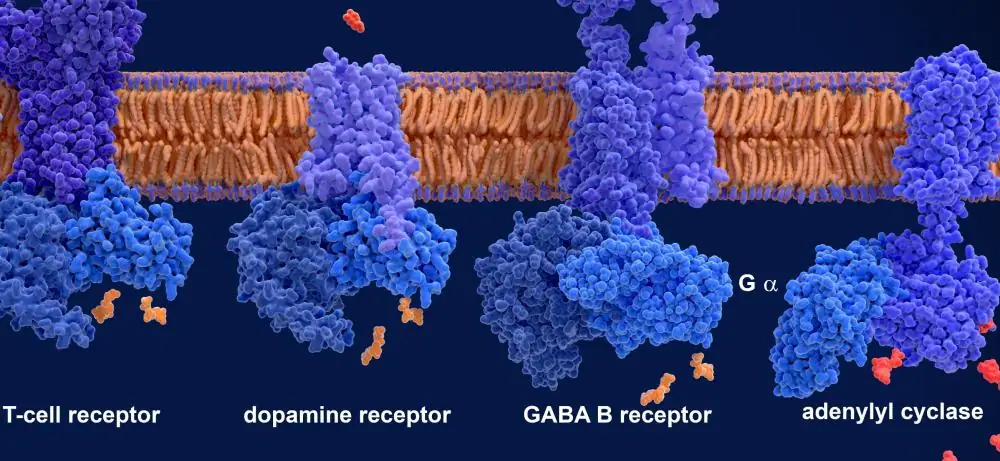
Cytokines and chemokines are both small proteins made by cells in the immune system. They are important in the production and growth of lymphocytes, and in regulating responses to infection or injury such as inflammation and wound healing. Cytokines are the general category of messenger molecules, while chemokines are a special type of cytokine that direct the migration (chemotaxis) of white blood cells to infected or damaged tissues. Unlike most other cytokines, chemokines regulate their action through interactions with seven-transmembrane, rhodopsin-like G protein-coupled receptors (GPCRs). Cytokines are secreted in the mammalian immune system, and used as messenger molecules to control the duration and strength of the immune response to foreign microorganisms. Many cytokines produced by T cells direct the immune response of various white blood cells (leukocytes) to a foreign microorganism in the body. Among the important varieties are the interleukin (IL) molecules and interferon alpha and beta. The ILs help regulate inflammation, fever, and wound healing, among other things, while the interferons block the replication of viruses. As part of the superfamily of cytokine receptors belongs to the large family of GPCR receptors (GPCR-A1 and A2), among which the CCR and CXC type chemokine receptors, Axon Ligands™ that interact with these receptors have thus been listed in the corresponding sections of the GPCR receptors as well. Additionally, the superfamily of cytokine receptors differentiates tumor necrosis factor (TNF) type receptors and interleukin (IL) type receptors, and a small sub-family of other cytokine receptors that do not fit into the previously lised subfamilies, based on either structure or function.

Read More
sort-descending
  • Apilimod
    1369
    The price depends on the options chosen on the product page

    From $121.00

  • Lenalidomide
    1793
    The price depends on the options chosen on the product page

    From $44.00

  • SPD 304
    2143
    The price depends on the options chosen on the product page

    From $159.50

  • SC 144 hydrochloride
    2324
    The price depends on the options chosen on the product page

    From $143.00

  • Apilimod dimesylate
    2500
    The price depends on the options chosen on the product page

    From $121.00

  • Pexidartinib
    2501
    The price depends on the options chosen on the product page

    From $66.00

  • GW 2580
    2571
    The price depends on the options chosen on the product page

    From $82.50

  • Ensemble Compound 159
    2800
    The price depends on the options chosen on the product page

    From Inquiry

  • DRI-C21045
    2887
    The price depends on the options chosen on the product page

    From $137.50

  • NSC745887
    2966
    The price depends on the options chosen on the product page

    From $104.50

  • RCGD 423
    2999
    The price depends on the options chosen on the product page

    From $104.50

  • PLX5622
    3054
    The price depends on the options chosen on the product page

    From $88.00

  • Pomalidomide
    3166
    The price depends on the options chosen on the product page

    From $66.00

  • 4-CPPC
    3189
    The price depends on the options chosen on the product page

    From $148.50

  • Thalidomide
    3324
    The price depends on the options chosen on the product page

    From $55.00

Items 1-15 of 21

More About Cytokine

Cytokines and chemokines are both small proteins made by cells in the immune system. They are important in the production and growth of lymphocytes, and in regulating responses to infection or injury such as inflammation and wound healing. Cytokines are the general category of messenger molecules, while chemokines are a special type of cytokine that direct the migration (chemotaxis) of white blood cells to infected or damaged tissues. Unlike most other cytokines, chemokines regulate their action through interactions with seven-transmembrane, rhodopsin-like G protein-coupled receptors (GPCRs)[1]. Cytokines are secreted in the mammalian immune system,  and used as messenger molecules to control the duration and strength of the immune response to foreign microorganisms. Many cytokines produced by T cells direct the immune response of various white blood cells (leukocytes) to a foreign microorganism in the body. Among the important varieties are the interleukin (IL) molecules and interferon alpha and beta. The ILs help regulate inflammation, fever, and wound healing, among other things, while the interferons block the replication of viruses[2],[3]. As part of the superfamily of cytokine receptors belongs to the large family of GPCR receptors (GPCR-A1 and A2), among which the CCR and CXC type chemokine receptors, Axon Ligands™ that interact with these receptors have thus been listed in the corresponding sections of the GPCR receptors as well. Additionally, the superfamily of cytokine receptors differentiates tumor necrosis factor (TNF) type receptors and interleukin (IL) type receptors, and a small sub-family of other cytokine receptors that do not fit into the previously lised subfamilies, based on either structure or function.


[1] M.J. Cameron, D.J. Kelvin. Cytokines, Chemokines and Their Receptors. Mdm. Curie Biosc. Dbase [Internet]. Landes Bioscience 2000.  http://www.ncbi.nlm.nih.gov/books/NBK6294/
[2] L.C. Borish, J.W. Steinke. 2. Cytokines and chemokines. J. Allergy Clin. Immunol. 2003, 111, S460-75.
[3] C.A. Dinarello. Historical Review of Cytokines. Eur. J. Immunol. 2007, 37, S34-S45.

Loading...