
Mer

Mer

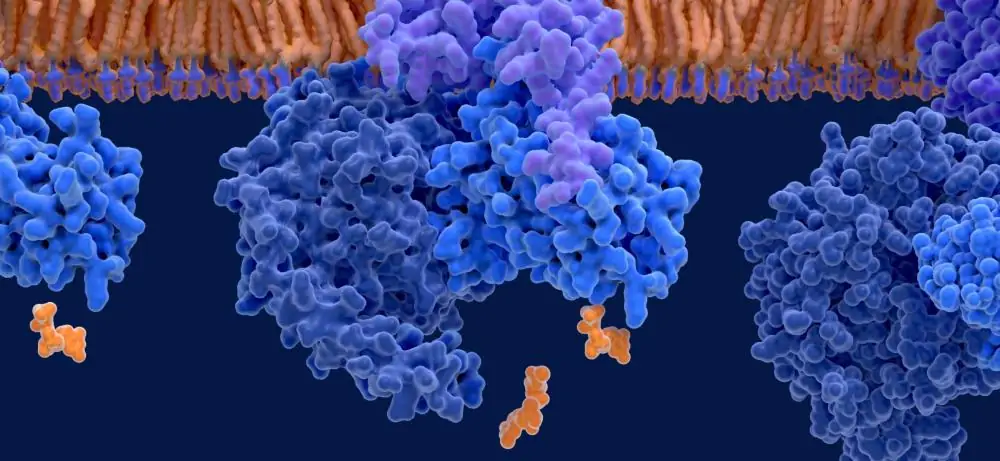
The protein encoded by this gene is a member of the receptor tyrosine kinase subfamily (RTK class IX). Mer belongs to the TAM (Tyro3, Axl, and Mer) RTK family, whose members function as inhibitors of innate inflammatory responses in dendritic cells and are essential to the prevention of lupus-like autoimmunity. Additionally, the members of this family of RTKs have been implicated in the development and metastasis of many cancers, including hematological malignancies and solid tumors of the colon, brain and breast. Although it is similar to other receptor tyrosine kinases, this protein represents a unique structure of the extracellular region that juxtaposes IgL and FNIII repeats. It transduces signals from the extracellular matrix into the cytoplasm by binding growth factors like vitamin K-dependent protein growth-arrest-specific gene 6. It is involved in the stimulation of cell proliferation and can also mediate cell aggregation by homophilic binding.

Read More
sort-descending
  • UNC569
    2086
    The price depends on the options chosen on the product page

    From $104.50

  • UNC2250
    2346
    The price depends on the options chosen on the product page

    From $88.00

  • LY 2801653
    2553
    The price depends on the options chosen on the product page

    From $132.00

  • MGCD516
    3998
    The price depends on the options chosen on the product page

    From Inquiry

4 Items

More About Mer

The protein encoded by this gene is a member of the receptor tyrosine kinase subfamily (RTK class IX). Mer belongs to the TAM (Tyro3, Axl, and Mer) RTK family, whose members function as inhibitors of innate inflammatory responses in dendritic cells and are essential to the prevention of lupus-like autoimmunity. Additionally, the members of this family of RTKs have been implicated in the development and metastasis of many cancers, including hematological malignancies and solid tumors of the colon, brain and breast.[1] Although it is similar to other receptor tyrosine kinases, this protein represents a unique structure of the extracellular region that juxtaposes IgL and FNIII repeats. It transduces signals from the extracellular matrix into the cytoplasm by binding growth factors like vitamin K-dependent protein growth-arrest-specific gene 6. It is involved in the stimulation of cell proliferation and can also mediate cell aggregation by homophilic binding[2].


[1] Mer or Axl receptor tyrosine kinase inhibition promotes apoptosis, blocks growth and enhances chemosensitivity of human non-small cell lung cancer. R.M.A. Linger et al. Oncogene 2012, 1–12.
[2] Identification of Axl as a downstream effector of TGF-β1 during Langerhans cell differentiation and epidermal homeostasis. Bauer T, Zagórska A, Jurkin J, Yasmin N, Köffel R, Richter S, Gesslbauer B, Lemke G, Strobl H. J. Exp. Med. 2012, 209, 2033-2047

Loading...