
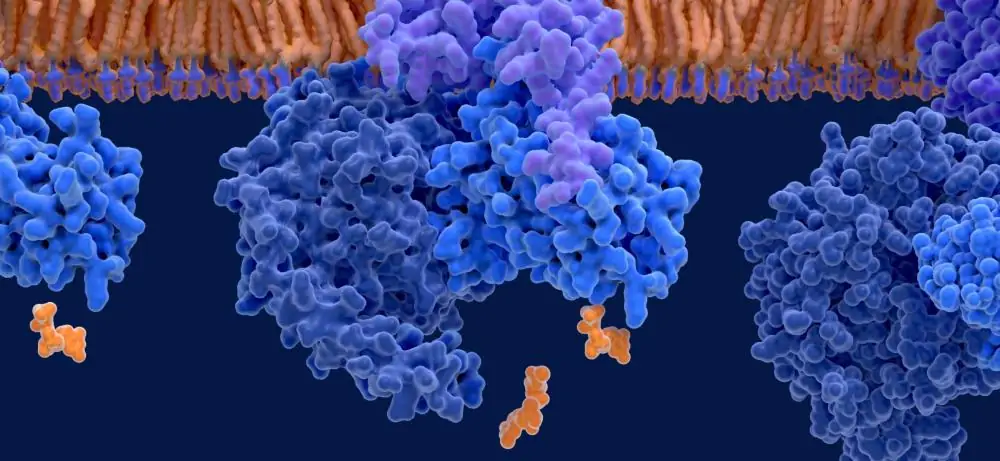
IGF1R

IGF1R

The pleiotropic actions of insulin are mediated by a single receptor tyrosine kinase (RTK class II, Insulin receptor family). A generally accepted paradigm is that insulin receptors, acting through insulin receptor substrates (insulin, and Insulin-like growth factors (IGF) I and II), stimulate the lipid kinase activity of phosphatidylinositol 3-kinase (PI3K). The rapid rise in Tris-phosphorylated inositol (PIP3) that ensues triggers a cascade of PIP3-dependent serine/threonine kinases. Among the latter, Akt and atypical protein kinase C isoforms are thought to be involved in insulin regulation of glucose transport and oxidation; glycogen, lipid, and protein synthesis; and modulation of gene expression. "Insulin insensitivity", or a decrease in insulin receptor signaling, leads to diabetes mellitus type 2 – the cells are unable to take up glucose, and the result is hyperglycemia (an increase in circulating glucose), and all the sequelae that result from diabetes.

Read More
sort-descending
  • OSI 906
    1702
    The price depends on the options chosen on the product page

    From $66.00

  • NT 157
    2238
    The price depends on the options chosen on the product page

    From $104.50

  • GSK 1838705A
    2267
    The price depends on the options chosen on the product page

    From $121.00

  • PQ401
    3341
    The price depends on the options chosen on the product page

    From $110.00

  • GSK1904529A
    3830
    The price depends on the options chosen on the product page

    From Inquiry

  • TAE226
    3866
    The price depends on the options chosen on the product page

    From $121.00

  • XL-228
    3973
    The price depends on the options chosen on the product page

    From Inquiry

  • Recently added
    I-OMe-Tyrphostin AG 538
    4489
    The price depends on the options chosen on the product page

    From $154.00

8 Items

More About IGF1R

The pleiotropic actions of insulin are mediated by a single receptor tyrosine kinase (RTK class II, Insulin receptor family). A generally accepted paradigm is that insulin receptors, acting through insulin receptor substrates (insulin, and Insulin-like growth factors (IGF) I and II), stimulate the lipid kinase activity of phosphatidylinositol 3-kinase (PI3K)[1]. The rapid rise in Tris-phosphorylated inositol (PIP3) that ensues triggers a cascade of PIP3-dependent serine/threonine kinases. Among the latter, Akt  and atypical protein kinase C isoforms are thought to be involved in insulin regulation of glucose transport and oxidation; glycogen, lipid, and protein synthesis; and modulation of gene expression. "Insulin insensitivity", or a decrease in insulin receptor signaling, leads to diabetes mellitus type 2 – the cells are unable to take up glucose, and the result is hyperglycemia (an increase in circulating glucose), and all the sequelae that result from diabetes.


[1] The Insulin Receptor and Its Cellular Targets. Y. Kido, J. Nakae, D. Accili. J. Clin.Endocrin. Met. 2001, 86, 972-979.

Loading...