
CHRM1

CHRM1

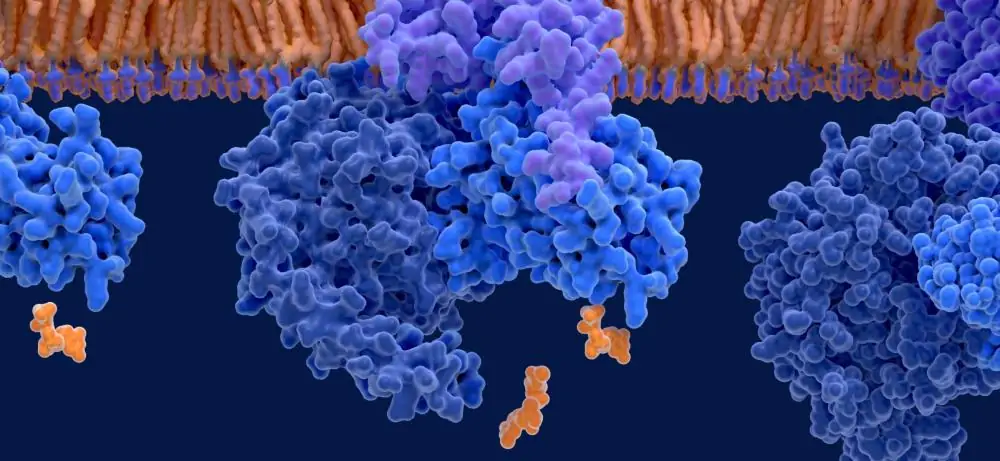
The class of transmembrane acetylcholine receptors can be divided into two main groups: the muscarinic (metabotropic) and the nicotinergic (ionotropic) receptors. This as a result of the specific binding affinities once determined of the two types of receptors for muscarine and nicotine respectively. The latter type is classified as a ligand gated ion channel, since activation of this receptor allows sodium ions to enter a cells interior and potassium and/or calcium ions to exit (section Ion channels (Ligand gated, Cys-loop, cationic). Unlike the nicotinergic acetylcholine receptor, the muscarinic type is part of the family of G-protein coupled receptors (GPCR-A18). In general, muscarinic acetylcholine receptors are known to play highly important and diverse roles in many basic physiological processes including gastrointestinal, cardiovascular, motor, attention, learning, memory, pain, sleep, and other functions. Four subtypes have been identified, localized and characterized (M1-M4), whereas a fifth member has been cloned (M5), yet its function has not been revealed completely. In order to facilitate the study of this most recent addition to the family of mACh receptors, Axon Medchem offers VU 0238429 (Axon 1786) as a high affinity drug (EC50 of approximately 1.16 µM at M5) with >30-fold selectivity versus M1 and M3, and no M2 or M4 potentiator activity.

Read More
sort-descending
  • Clozapine
    1146
    The price depends on the options chosen on the product page

    From $55.00

  • GMC 1-165
    1152
    The price depends on the options chosen on the product page

    From $154.00

  • GMC 1-109
    1289
    The price depends on the options chosen on the product page

    From $137.50

  • Olanzapine
    1298
    The price depends on the options chosen on the product page

    From $82.50

  • VU 0357017 hydrochloride
    1703
    The price depends on the options chosen on the product page

    From $126.50

  • VU 0255035
    1787
    The price depends on the options chosen on the product page

    From $132.00

  • VU 0029767
    1988
    The price depends on the options chosen on the product page

    From $121.00

  • Tolterodine L-tartrate
    2049
    The price depends on the options chosen on the product page

    From $77.00

  • TBPB
    2463
    The price depends on the options chosen on the product page

    From $115.50

  • GMC 1-161
    2851
    The price depends on the options chosen on the product page

    From $148.50

  • VU0486846
    3271
    The price depends on the options chosen on the product page

    From $181.50

  • Oxybutynin hydrochloride
    3505
    The price depends on the options chosen on the product page

    From $55.00

  • Bethanechol chloride
    3513
    The price depends on the options chosen on the product page

    From $55.00

  • Trospium chloride
    3648
    The price depends on the options chosen on the product page

    From $66.00

14 Items

More About CHRM1

The class of transmembrane acetylcholine receptors can be divided into two main groups: the muscarinic (metabotropic) and the nicotinergic (ionotropic) receptors. This as a result of the specific binding affinities once determined of the two types of receptors for muscarine and nicotine respectively[1],[2].  The latter type is classified as a ligand gated ion channel, since activation of this receptor allows sodium ions to enter a cells interior and potassium and/or calcium ions to exit (section Ion channels (Ligand gated, Cys-loop, cationic)[3]. Unlike the nicotinergic acetylcholine receptor, the muscarinic type is part of the family of G-protein coupled receptors (GPCR-A18). In general, muscarinic acetylcholine receptors are known to play highly important and diverse roles in many basic physiological processes including gastrointestinal, cardiovascular, motor, attention, learning, memory, pain, sleep, and other functions[4]. Four subtypes have been identified, localized and characterized (M1-M4), whereas a fifth member has been cloned (M5), yet its function has not been revealed completely[5],[6]. In order to facilitate the study of this most recent addition to the family of mACh receptors, Axon Medchem offers VU 0238429 (Axon 1786) as a  high affinity drug (EC50 of approximately 1.16 µM at M5) with >30-fold selectivity versus M1 and M3, and no M2 or M4 potentiator activity.

Acetylcholine receptor subtypes listed: CHRM1, CHRM3, CHRM4, CHRM5


[1] The pharmacology of flaxedil with observations on certain analogs. Riker WF, Wescoe WC. Ann NY Acad Sci 1951, 54, 373–394.
[2] The Chemical Transmission of Nerve Action. O. Loewi. Nobel Lecture,December 12, 1936.
[3] Purves, Dale, George J. Augustine, David Fitzpatrick, William C. Hall, Anthony-Samuel LaMantia, James O. McNamara, and Leonard E. White (2008). Neuroscience. 4th ed.. Sinauer Associates. pp. 122–6. ISBN 978-0-87893-697-7.
[4] Cloning and Expression of the Human and Rat m5 Muscarinic Acetylcholine Receptor Genes. Bonner, T. I.; Young, A. C.; Brann, M. R.; Buckley, N. J. Neuron 1988, 1, 403–410.
[5] Muscarinic acetylcholine receptor subtypes: localization and structure/function. Brann MR, Ellis J, Jørgensen H, Hill-Eubanks D, Jones SV. Prog Brain Res. 1993, 98, 121-7.
[6] Discovery of the first highly M5-preferring muscarinic acetylcholine receptor ligand, an M5 positive allosteric modulator derived from a series of 5-trifluoromethoxy N-benzyl isatins. Bridges TM, Marlo JE, Niswender CM, et al. J. Med. Chem. 2009, 52, 3445–8.

Loading...