Bulk Inquiry
R(-)-N-Propylnorapomorphine hydrobromide
- NPA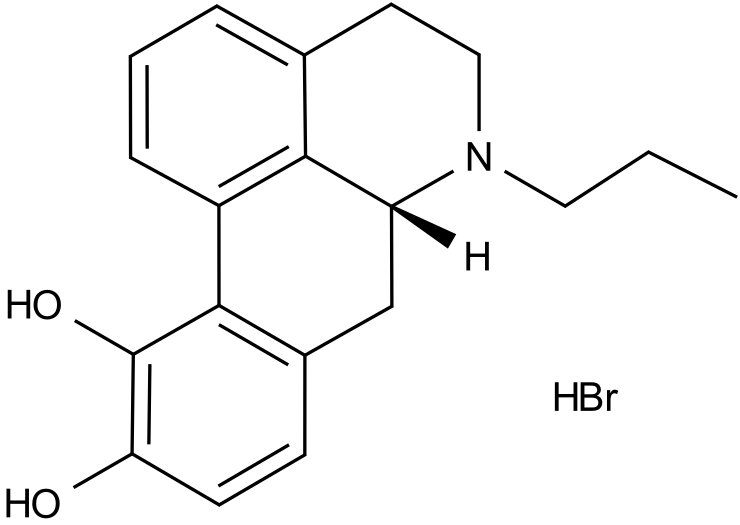
- Parent CAS: 18426-20-5
- Optical Purity: >98% e.e.
- Soluble in 0.1N HCl(aq) and DMSO
- MF: C19H21NO2.HBr
- MW: 376.29
Description
R(-)-N-Propylnorapomorphine hydrobromide (NPA) is a highly potent and selective dopamine D2/D3 receptor agonist. It is an apomorphine-related ligand useful for activating D2 receptor signaling in dopaminergic pharmacology studies. But it is approximately 10 to 20 times more potent than Apomorphine.
In low doses, it acts as a preferential stimulant of dopamine autoreceptors, leading to decreased dopamine synthesis, reduced firing rate of dopaminergic neurons, and a decrease in motor activity. At higher doses, it triggers postsynaptic receptors, reversing these effects and enhancing locomotor activity.
D2 receptor agonists are used to investigate motor circuitry, reward pathways, neuroendocrine regulation and dopaminergic GPCR signaling. R(-)-N-Propylnorapomorphine hydrobromide is suited for experiments requiring potent D2 receptor activation.
Key Features
- Highly potent dopamine D2/D3 receptor agonist
- Selective dopaminergic ligand
- Apomorphine-related analogue
- Activates dopamine D2 receptor-mediated signaling
Applications
- D2/D3 receptor pharmacology
- Dopaminergic signaling assays
- CNS receptor activation studies
- Dopamine agonist structure-activity research
More Information
| Parent CAS No. | 18426-20-5 |
|---|---|
| Chemical Name | (R)-6-Propyl-5,6,6a,7-tetrahydro-4H-dibenzo[de,g]quinoline-10,11-diol hydrobromide |
| SMILES | C1C=C2CCN(CCC)[C@]3([H])CC4C=CC(O)=C(O)C=4C(=C23)C=1.Br |&1:9,r| |
| MFCD | N.A. |
| InChi | InChI=1S/C19H21NO2.BrH/c1-2-9-20-10-8-12-4-3-5-14-17(12)15(20)11-13-6-7-16(21)19(22)18(13)14;/h3-7,15,21-22H,2,8-11H2,1H3;1H/t15-;/m1./s1 |
| InChiKey | VEBNABIHXQQASR-XFULWGLBSA-N |
| CID | 91826452 |
| Short Description | D2 agonist |