
Bulk Inquiry
ST 198
Axon 1343
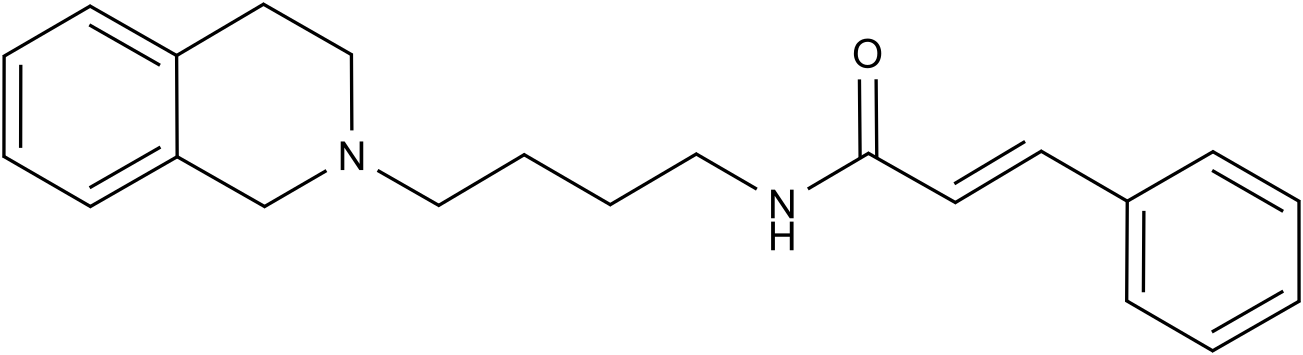
CAS:
854924-64-4
Purity:
99%
- No solubility data
- MF: C22H26N2O
- MW: 334.45
Description
ST 198 is a dopamine D3 receptor antagonist.
D3 receptors are enriched in limbic regions and are implicated in reward, motivation, cognition and addiction-related circuitry. ST 198 is useful for studying D3 receptor blockade and D2/D3 subtype selectivity.
Key Features
- Dopamine D3 receptor antagonist
- Targets limbic dopamine receptor signaling
- Useful for D3 versus D2 subtype studies
- Relevant to reward and addiction pathway research
Applications
- D3 receptor binding assays
- Dopamine receptor subtype profiling
- Reward circuitry and addiction model research
- CNS dopaminergic signaling studies
More Information
| Parent CAS No. | 854924-64-4 |
|---|---|
| Chemical Name | (E)-N-[4-(3,4-Dihydro-1H-isoquinolin-2-yl)-butyl]-3-phenyl-acrylamide |
| SMILES | C1C=C2CCN(CCCCNC(/C=C/C3C=CC=CC=3)=O)CC2=CC=1 |
| MFCD | MFCD12546326 |
| InChi | InChI=1S/C22H26N2O/c25-22(13-12-19-8-2-1-3-9-19)23-15-6-7-16-24-17-14-20-10-4-5-11-21(20)18-24/h1-5,8-13H,6-7,14-18H2,(H,23,25)/b13-12+ |
| InChiKey | GQPJBOOQHWEOKT-OUKQBFOZSA-N |
| CID | 10065496 |
| Short Description | D3 antagonist |
ST 198
dopamine D3 receptor antagonist
ST198
DRD3
dopamine D3 receptor
D3
Antagonist
dopamine signaling
D3 receptor binding assays
Dopamine receptor subtype profiling
Reward circuitry and addiction model research
CNS dopaminergic signaling studies
cognition
addiction research
GPCR pharmacology
receptor selectivity
signal transduction
CNS
CAS 854924-64-4
Axon Medchem
Axon 1343
Supplier
Vendor
References
- P Pyrko. HIV-1 protease inhibitors nelfinavir and atazanavir induce malignant glioma death by triggering endoplasmic reticulum stress. Cancer Res. 2007, 67, 10920–8.
- JJ Gills et al. Nelfinavir, A Lead HIV Protease Inhibitor, Is a Broad-Spectrum, Anticancer Agent that Induces Endoplasmic Reticulum Stress, Autophagy, and Apoptosis In vitro and In vivo. Clin. Cancer Res. 2007, 13(17), 5183–5194.
- WA Chow et al. Anti-HIV drugs for cancer therapeutics: back to the future?. Lancet Oncol. 2009, 10 (1), 61–71.
Related Products
Other Categories
Get a Quote for
Loading...