
Bulk Inquiry
UNC9994 hydrochloride
Axon 2562
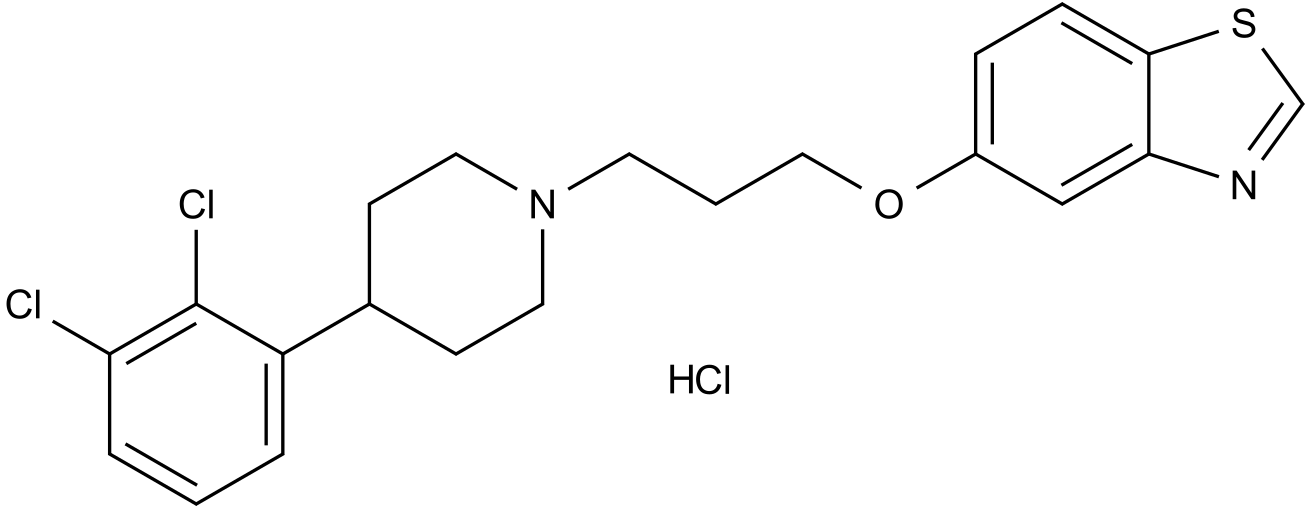
- Parent CAS: 1354030-51-5
Purity:
99%
- Soluble in DMSO
- MF: C21H22Cl2N2OS.HCl
- MW: 457.84
Description
UNC9994 hydrochloride is a β-arrestin-biased, functionally selective dopamine D2 receptor agonist that exhibits antipsychotic activity in vivo. UNC9994 markedly inhibited PCP-induced hyperlocomotion in wild-type mice, which effect was completely abolished in β-arrestin-2 knockout mice. It preferentially recruits β-arrestin-2 signaling and exhibits antipsychotic-like activity in reported preclinical models.
D2 receptors regulate dopaminergic signaling in motor, reward, endocrine and psychiatric circuits through both G protein and β-arrestin pathways. UNC9994 hydrochloride is useful for studying functional selectivity and biased agonism at D2 receptors.
Key Features
- Unique β-arrestin-biased dopamine D2 receptor agonist
- Reported Ki: 30 nM and EC50: 50 nM in β-arrestin-2 recruitment assays
- Functionally selective D2R signaling profile
- Shows antipsychotic-like activity in reported animal models
Applications
- Dopamine D2 receptor pharmacology
- Biased agonism and β-arrestin signaling studies
- Neuropsychiatric drug mechanism research
- GPCR functional selectivity assays
More Information
| Parent CAS No. | 1354030-51-5 |
|---|---|
| Chemical Name | 5-(3-(4-(2,3-dichlorophenyl)piperidin-1-yl)propoxy)benzo[d]thiazole hydrochloride |
| SMILES | S1C2=CC=C(OCCCN3CCC(C4=CC=CC(Cl)=C4Cl)CC3)C=C2N=C1.Cl |
| MFCD | N.A. |
| InChi | InChI=1S/C21H22Cl2N2OS.ClH/c22-18-4-1-3-17(21(18)23)15-7-10-25(11-8-15)9-2-12-26-16-5-6-20-19(13-16)24-14-27-20;/h1,3-6,13-15H,2,7-12H2;1H |
| InChiKey | MTDQOQYYKZUEEK-UHFFFAOYSA-N |
| CID | 121230971 |
| Short Description | D2 agonist |
References
- X Chen et al Structure-functional selectivity relationship studies of β-arrestin-biased dopamine D₂ receptor agonists. J Med Chem. 2012 Aug 23;55(16):7141-53.
- JA Allen et al. Discovery of β-arrestin-biased dopamine D2 ligands for probing signal transduction pathways essential for antipsychotic efficacy. Proc Natl Acad Sci U S A. 2011 Nov 8;108(45):18488-93.
Related Products
Other Categories

Get a Quote for
Loading...