
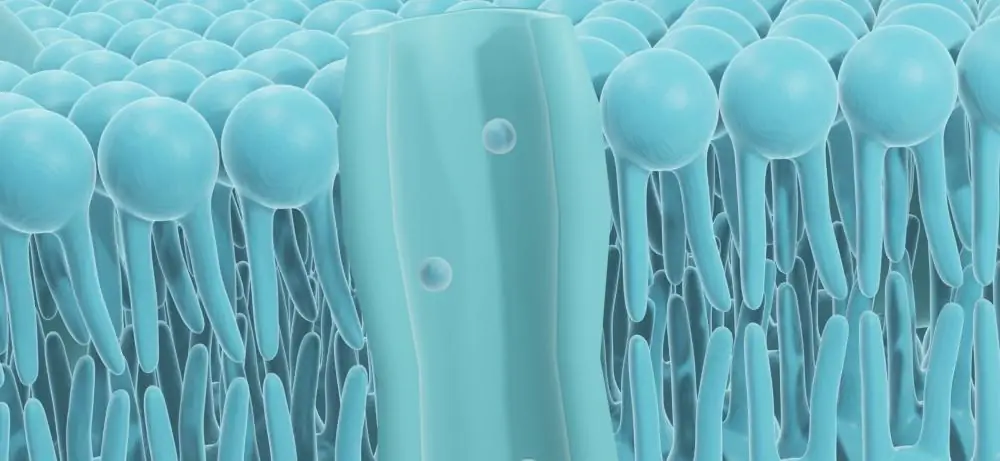
Glutamate, ionotropic

Glutamate, ionotropic

L-glutamate is the major excitatory neurotransmitter in the central nervous system. The glutamate system represents an attractive molecular target in the treatment of epilepsy, neurodegenerative diseases (Alzheimer’s disease, Parkinson’s disease, Huntington’s chorea), schizophrenia, ischemia, pain, alcoholism and mood disorders. Alpha-amino-3-hydroxy-5-methyl-4-isoxazolepropionic acid (AMPA) is an artificial glutamate analogue. Its receptor (originally named quisqualate receptor) is a non-NMDA-type ionotropic transmembrane receptor for glutamate that mediates fast synaptic transmission in the central nervous system. Like all ionotropic glutamate receptors, it consists of tetramers of four different types of subunits (GluR1-GluR4). The AMPA receptor GluA2 (GluR2) tetramer was the first and currently only glutamate receptor ion channel to be crystallized.Kainate, a natural product, is an excitotoxic glutamate analogue produced by an algae, while NMDA is N-methyl-d-aspartate. Although all three glutamate receptor subtypes respond to glutamate, they can be distinguished by their response to these artificial agonists. Their distribution in the brain, physiological function, and mechanism and kinetics of activation and regulation are very different. In two ways, the NMDA receptor is distinct from the other LGICs. First, it is both ligand-gated and voltage-dependent. Second, it requires co-activation by two ligands: glutamate and either d-serine or glycine. What’s more, the receptor controls a cation channel that is highly permeable to multiple monovalent ions and calcium.

Read More
sort-descending
  • Ifenprodil L-(+)-tartrate
    1156
    The price depends on the options chosen on the product page

    From $60.50

  • CNQX
    1200
    The price depends on the options chosen on the product page

    From $93.50

  • DNQX
    1201
    The price depends on the options chosen on the product page

    From $55.00

  • CFM 2
    1217
    The price depends on the options chosen on the product page

    From $126.50

  • Eliprodil
    1246
    The price depends on the options chosen on the product page

    From $99.00

  • N 20C hydrochloride
    1249
    The price depends on the options chosen on the product page

    From $93.50

  • Gavestinel
    1262
    The price depends on the options chosen on the product page

    From $121.00

  • YM 90K hydrochloride
    1312
    The price depends on the options chosen on the product page

    From $93.50

  • RO 25-6981 hydrochloride
    1314
    The price depends on the options chosen on the product page

    From $121.00

  • Lamotrigine
    1353
    The price depends on the options chosen on the product page

    From $66.00

  • GYKI 53655
    1374
    The price depends on the options chosen on the product page

    From $143.00

  • CP 101606 mesylate
    1406
    The price depends on the options chosen on the product page

    From $93.50

  • RGH 896
    1434
    The price depends on the options chosen on the product page

    From $104.50

  • S 18986
    1788
    The price depends on the options chosen on the product page

    From $115.50

  • CMPDA
    2079
    The price depends on the options chosen on the product page

    From $93.50

More About Glutamate, ionotropic

L-glutamate is the major excitatory neurotransmitter in the central nervous system. The glutamate system represents an attractive molecular target in the treatment of epilepsy, neurodegenerative diseases (Alzheimer’s disease, Parkinson’s disease, Huntington’s chorea), schizophrenia, ischemia, pain, alcoholism and mood disorders[1].
Alpha-amino-3-hydroxy-5-methyl-4-isoxazolepropionic acid (AMPA) is an artificial glutamate analogue. Its receptor (originally named quisqualate receptor) is a non-NMDA-type ionotropic transmembrane receptor for glutamate that mediates fast synaptic transmission in the central nervous system. Like all ionotropic glutamate receptors, it consists of tetramers of four different types of subunits (GluR1-GluR4). The AMPA receptor GluA2 (GluR2) tetramer was the first and currently only glutamate receptor ion channel to be crystallized[2].
Kainate, a natural product, is an excitotoxic glutamate analogue produced by an algae, while NMDA is N-methyl-d-aspartate. Although all three glutamate receptor subtypes respond to glutamate, they can be distinguished by their response to these artificial agonists. Their distribution in the brain, physiological function, and mechanism and kinetics of activation and regulation are very different[3]. In two ways, the NMDA receptor is distinct from the other LGICs. First, it is both ligand-gated and voltage-dependent. Second, it requires co-activation by two ligands: glutamate and either d-serine or glycine. What’s more, the receptor controls a cation channel that is highly permeable to multiple monovalent ions and calcium[4]


[1] Molecular structure of ionotropic glutamate receptors. A.A. Kaczor, D. Matosiuk. Curr Med Chem. 2010,17, 2608-2635.
[2] AMPA receptors as drug targets in neurological disease--advantages, caveats, and future outlook. P.K. Chang, D. Verbich, R.A. McKinney. Eur. J. Neurosci. 2012, 35, 1908-1916.
[3] Kainate receptors. P. Pinheiro, C. Mulle. Cell and Tissue Research. 2006, 326, 457-482.
[4] The Role of N-Methyl-D-Aspartate (NMDA) Receptors in Pain: A Review. A.B. Petrenko et al. Anest. Analg. 2003, 97, 1108-1116

Loading...