Bulk Inquiry
CHIR99021 dihydrochloride
- CT99021 dihydrochloride - Laduviglusib dihydrochloride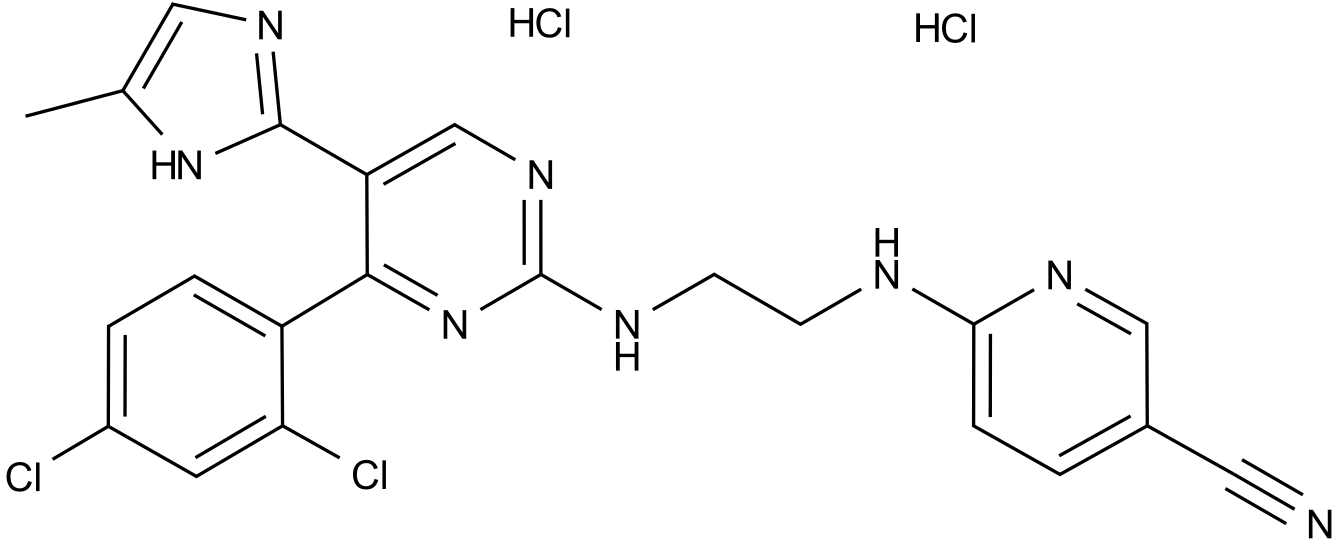
- Parent CAS: 252917-06-9
- Soluble in water and DMSO
- MF: C22H18Cl2N8.2HCl
- MW: 538.26
Description
CHIR99021 dihydrochloride is the water-soluble hydrochloride salt of CHIR99021 (CT99021, Laduviglusib), a highly potent and selective glycogen synthase kinase-3 (GSK-3) inhibitor with IC50 values of 10 nM and 6.7 nM for GSK-3α and GSK-3β, respectively. By inhibiting GSK-3, a key negative regulator of the Wnt/β-catenin pathway, CHIR99021 dihydrochloride activates canonical Wnt signaling and promotes β-catenin-mediated transcription.
CHIR99021 dihydrochloride is one of the most widely used small molecules in stem cell biology and regenerative medicine. Activation of Wnt/β-catenin signaling supports stem cell self-renewal, pluripotency maintenance, cellular reprogramming, and lineage specification. In combination with PD0325901 (Axon 1408), CHIR99021 forms the classic 2i culture system (Axon 2128), which supports maintenance of naïve pluripotency in embryonic stem cells (ESCs) and induced pluripotent stem cells (iPSCs). CHIR99021 is also a core component of numerous stem cell culture systems, including 3i, 4i, 5i, and naïve stem cell protocols. The water-soluble dihydrochloride salt provides a convenient alternative for applications requiring aqueous formulations while maintaining the biological activity of the parent compound.
Key Features
- Water-soluble dihydrochloride salt of CHIR99021
- Highly potent and selective GSK-3α/β inhibitor
- Potent activator of Wnt/β-catenin signaling
- Core component of the classic 2i stem cell culture system
- Widely used in pluripotency, reprogramming, and organoid research
Applications
- Stem cell self-renewal and pluripotency studies
- ESC and iPSC culture systems
- Cellular reprogramming and regenerative medicine research
- Wnt/β-catenin signaling investigations
- Organoid, developmental biology, and differentiation studies
*Promotion: Buy 2i inhibitor set | Axon 2128.
Prime Source Information:
CHIR99021 from Axon Medchem has been procured by many labs as drug standard for generating reliable and reproducible biological data, evidenced by many recent publications (>750 citations). It is pure not only chemically but also biologically.
More Information
| Parent CAS No. | 252917-06-9 |
|---|---|
| Chemical Name | 6-{2-[4-(2,4-Dichloro-phenyl)-5-(5-methyl-1H-imidazol-2-yl)-pyrimidin-2-ylamino]-ethylamino}-nicotinonitrile dihydrochloride |
| SMILES | C1(NCCNC2N=C(C3C(Cl)=CC(Cl)=CC=3)C(C3NC(C)=CN=3)=CN=2)N=CC(C#N)=CC=1.Cl.Cl |
| MFCD | MFCD11846251 |
| InChi | InChI=1S/C22H18Cl2N8.2ClH/c1-13-10-29-21(31-13)17-12-30-22(32-20(17)16-4-3-15(23)8-18(16)24)27-7-6-26-19-5-2-14(9-25)11-28-19;;/h2-5,8,10-12H,6-7H2,1H3,(H,26,28)(H,29,31)(H,27,30,32);2*1H |
| InChiKey | OOMHEMQQCHEWDS-UHFFFAOYSA-N |
| CID | 91826519 |
| Short Description | GSK-3 inhibitor |
References
- C Tong et al. Generating gene knockout rats by homologous recombination in embryonic stem cells. Nature Protocols 2011, 6, 827–844.
- M Kawamata and T Ochiya. Generation of genetically modified rats from embryonic stem cells. PNAS 2010, 107(32), 14223-14228.
- MY Chang et al. Direct Reprogramming of Rat Neural Precursor Cells and Fibroblasts into Pluripotent Stem Cells. PLoS One. 2010, 5(3), e9838.
- IM Aparicio et al. Identification and regulation of glycogen synthase kinase-3 during bovine embryo development. Reproduction 2010, 140, 83-92.
- B Zimmer et al. Coordinated waves of gene expression during neuronal differentiation of embryonic stem cells as basis for novel approaches to developmental neurotoxicity testing. Cell Death and Differentiation. 2011, 18, 383–395.
- Q.L.Ying et al. The ground state of embryonic stem cell self-renewal. Nature. 2008, 453, 519-523.
- J. Bain et al. The selectivity of protein kinase inhibitors: a further update. Biochem. J. 2007, 408, 297-315.
- D.B. Ring et al. Selective glycogen synthase kinase 3 inhibitors potentiate insulin activation of glucose transport and utilization in vitro and in vivo. Diabetes. 2003, 52, 588-595.
- A.S. Wagman et al. Discovery and development of GSK3 inhibitors for the treatment of type 2 diabetes. Curr. Pharm. Des. 2004, 10, 1105-1137.
Related Products
| AXON ID | NAME | FROM PRICE |
|---|---|---|
| 1126 | CHIR98014 |
From $108.90 |
| 1303 | SB 216763 |
From $93.50 |
| 1386 | CHIR99021 |
From $66.00 |
| 1527 | XAV939 |
From $88.00 |
| 1562 | TWS 119 |
From $77.00 |
| 1693 | BIO |
From $99.00 |
| 1766 | ICG 001 |
From $126.50 |
| 1909 | A 1070722 |
From $104.50 |
| 1922 | JW 55 |
From $104.50 |
| 2010 | TDZD 8 |
From $99.00 |
| 2036 | KY 02111 |
From $88.00 |
| 2084 | SKL 2001 |
From $99.00 |
| 2120 | Wnt agonist 1 |
From $99.00 |
| 2133 | iCRT5 |
From $99.00 |
| 2167 | AR-A 014418 |
From $93.50 |
| 2171 | AZD1080 |
From $99.00 |
| 2188 | WAY 262611 dihydrochloride |
From $137.50 |
| 2194 | AZD2858 hydrochloride |
From $104.50 |
| 2212 | IWP L6 |
From $143.00 |
| 2287 | Wnt-C59 |
From $82.50 |
| 2511 | IM 12 |
From $104.50 |
| 2931 | BRD0705 |
From $231.00 |
| 3153 | BRD5648 |
From $198.00 |
| 3154 | rac-BRD0705 |
From $132.00 |