
Bulk Inquiry
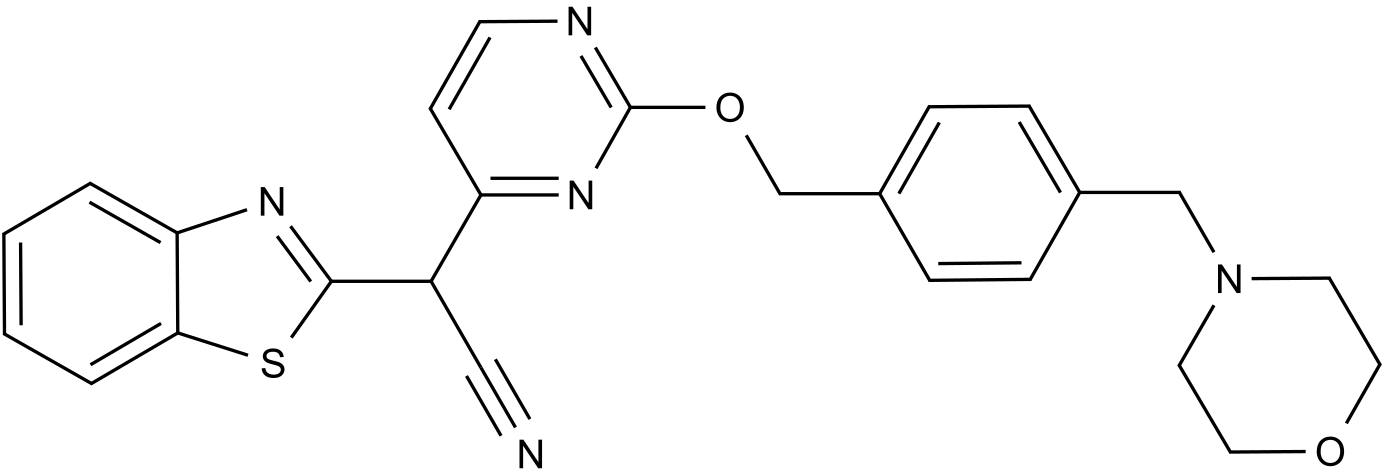
Bentamapimod
- AS602801
Axon 2002
CAS:
848344-36-5
Purity:
98%
- Soluble in 0.1N HCl(aq) and DMSO
- MF: C25H23N5O2S
- MW: 457.55
Description
Bentamapimod (AS602801) is a potent, orally active and selective c-Jun N-terminal kinase (JNK) inhibitor with IC50 values of 80 nM, 90 nM and 230 nM for JNK1, JNK2 and JNK3, respectively. Bentamapimod inhibits JNK signaling, blocks T-lymphocyte proliferation, and induces apoptosis.
The JNK pathway is a key component of mitogen-activated protein kinase (MAPK) signaling and regulates cellular stress responses, inflammation, apoptosis, and immune cell activation, making JNK an important target in inflammation, oncology, and immune-mediated disease research.
Key Features
- Potent and selective JNK inhibitor
- IC50: 80 nM (JNK1), 90 nM (JNK2), 230 nM (JNK3)
- Orally active compound
- Blocks T-lymphocyte proliferation
- Induces apoptosis
Applications
- JNK and MAPK signaling research
- Inflammation and immune response studies
- T-cell activation and proliferation research
- Apoptosis and cell death pathway analysis
- Cancer and immune-mediated disease models
More Information
| Parent CAS No. | 848344-36-5 |
|---|---|
| Chemical Name | 2-(benzo[d]thiazol-2-yl)-2-(2-(4-(morpholinomethyl)benzyloxy)pyrimidin-4-yl)acetonitrile |
| SMILES | S1C2=CC=CC=C2N=C1C(C1C=CN=C(OCC2=CC=C(CN3CCOCC3)C=C2)N=1)C#N |
| MFCD | MFCD08272350 |
| InChi | InChI=1S/C25H23N5O2S/c26-15-20(24-28-22-3-1-2-4-23(22)33-24)21-9-10-27-25(29-21)32-17-19-7-5-18(6-8-19)16-30-11-13-31-14-12-30/h1-10,20H,11-14,16-17H2 |
| InChiKey | XCPPIJCBCWUBNT-UHFFFAOYSA-N |
| CID | 10195250 |
| Short Description | JNK inhibitor |
Bentamapimod
AS602801
AS 602801
AS-602801
JNK inhibitor
c-Jun N-terminal kinase inhibitor
JNK1 inhibitor
JNK2 inhibitor
JNK3 inhibitor
MAPK inhibitor
MAPK signaling
T-lymphocyte proliferation
apoptosis
immune response
inflammation
CAS 848344-36-5
Axon Medchem
Axon 2002
MAPK
MAPK (JNK)
Kinases (JNK)
Enzymes
Supplier
Vendor
References
- S Halazy. Designing heterocyclic selective kinase inhibitors: from concept to new drug candidates. ARKIVOC 2006 (vii) 496-508.
- C Chiara Ferrandi et al. Characterization of immune cell subsets during the active phase of multiple sclerosis reveals disease and c-Jun N-terminal kinase pathway biomarkers. Mult. Scler. J. 2011, 17(1), 43-56.
- SS Bhagwat. Chapter 17 MAP Kinase Inhibitors in Inflammation and Autoimmune Disorders. Ann. Rep. Med. Chem. 2007, 42, 265-278.
Other Categories
Get a Quote for
Loading...