
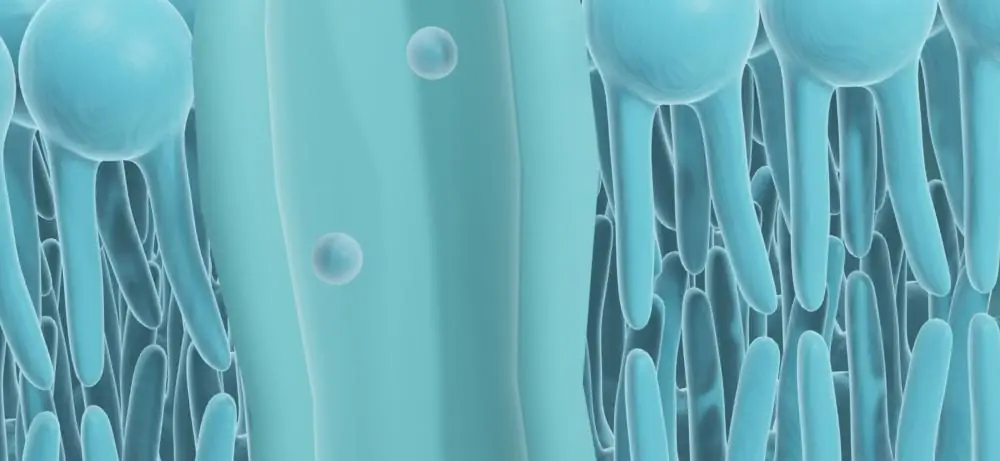
GABA-A

GABA-A

The Cys-loop class of LGICs forms a superfamily of ionotropic receptors that includes two types of anion-permeable channels, which are represented by receptors for the neurotransmitters GABA (gamma-aminobutyric acid) and glycine, and allow negatively charged chloride ions to migrate through the cell membrane. Activation of these receptors in general leads to rapid inhibitory synaptic transmission. Upon activation, the GABAA receptor selectively conducts Cl- through its pore, resulting in hyperpolarization of the neuron. This causes an inhibitory effect on neurotransmission by diminishing the chance of a successful action potential occurring. Mild inhibition of neuronal firing by drugs acting at the GABAA receptor causes a reduction of anxiety in the patient (an anxiolytic effect) while more pronounced inhibition induces general anesthesia. As a consequence of its high affinity binding to its natural inhibitor, strychnine, the GlyR was the first nicotinicoid receptor isolated from mammalian nervous tissue. Structurally and functionally, the glycine receptor is most closely related to the GABAA receptor. GlyRs are primarily expressed in spinal cord, brain stem, caudal brain, and retina. In adult neurons, the inhibitory chloride influx upon glycine receptor activation stabilizes the resting potential of the cell, rendering them electrically quiescent. Reduced channel expression and/or reduced activity of mutants often result in channelopathies involving muscle tone regulation, such as human startle disease (hyperekplexia).

Read More
sort-descending
  • NBI 34060
    1121
    The price depends on the options chosen on the product page

    From $110.00

  • SL 651498
    1195
    The price depends on the options chosen on the product page

    From $88.00

  • L 838417
    1196
    The price depends on the options chosen on the product page

    From $132.00

  • Zopiclone
    1197
    The price depends on the options chosen on the product page

    From $77.00

  • PK 11195
    1208
    The price depends on the options chosen on the product page

    From $71.50

  • Gabapentin
    1301
    The price depends on the options chosen on the product page

    From $71.50

  • TP003
    1422
    The price depends on the options chosen on the product page

    From $88.00

  • NS 11394
    1457
    The price depends on the options chosen on the product page

    From $121.00

  • (+)-Pagoclone
    1594
    The price depends on the options chosen on the product page

    From $148.50

  • CP 615003 mesylate
    1604
    The price depends on the options chosen on the product page

    From $99.00

  • Zaleplon
    1646
    The price depends on the options chosen on the product page

    From $77.00

  • (R)-(-)-N-Desmethyl-PK 11195
    2784
    The price depends on the options chosen on the product page

    From $176.00

  • (R)-(-)-PK 11195
    2785
    The price depends on the options chosen on the product page

    From $143.00

  • N-Desmethyl-PK 11195
    2833
    The price depends on the options chosen on the product page

    From $121.00

  • AZD6280
    3042
    The price depends on the options chosen on the product page

    From $137.50

Items 1-15 of 23

More About GABA-A

The Cys-loop class of LGICs forms a superfamily of ionotropic receptors that includes two types of anion-permeable channels, which are represented by receptors for the neurotransmitters GABA (gamma-aminobutyric acid) and glycine, and allow negatively charged chloride ions to migrate through the cell membrane. Activation of these receptors in general leads to rapid inhibitory synaptic transmission[1].
Upon activation, the GABAA receptor selectively conducts Cl- through its pore, resulting in hyperpolarization of the neuron. This causes an inhibitory effect on neurotransmission by diminishing the chance of a successful action potential occurring. Mild inhibition of neuronal firing by drugs acting at the GABAA receptor causes a reduction of anxiety in the patient (an anxiolytic effect) while more pronounced inhibition induces general anesthesia[2].
As a consequence of its high affinity binding to its natural inhibitor, strychnine, the GlyR was the first nicotinicoid receptor isolated from mammalian nervous tissue. Structurally and functionally, the glycine receptor is most closely related to the GABAA receptor. GlyRs are primarily expressed in spinal cord, brain stem, caudal brain, and retina. In adult neurons, the inhibitory chloride influx upon glycine receptor activation stabilizes the resting potential of the cell, rendering them electrically quiescent. Reduced channel expression and/or reduced activity of mutants often result in channelopathies involving muscle tone regulation, such as human startle disease (hyperekplexia)[3].


[1] Novel animal-health drug targets from ligand-gated chloride channels. V. Raymond, D.B. Sattelle. Nat. Rev. Drug Discov. 2002, 1, 427-436.
[2] Structure, Function, and Modulation of GABAA Receptors. E. Sigel M.E. Steinmann. J. Biol. Chem. 2012, 287, 40224-40231.
[3] Structure and Function of the Glycine Receptor and Related Nicotinicoid Receptors. M. Cascio. J. Biol. Chem. 2004, 279, 19383-19386.

Loading...