Bulk Inquiry
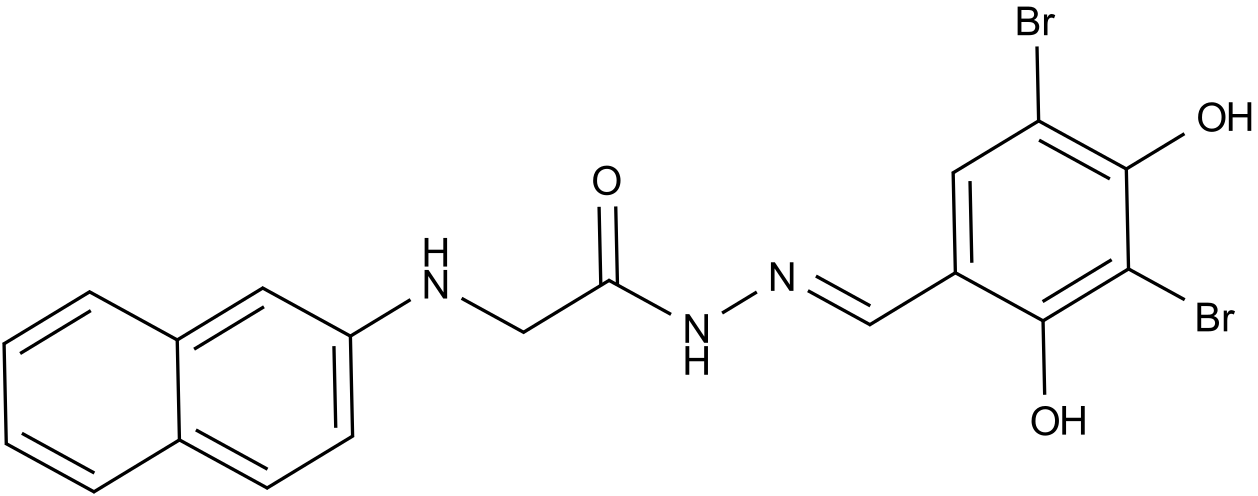
GlyH 101
- Soluble in DMSO
- MF: C19H15Br2N3O3
- MW: 493.15
Description
GlyH 101 is a potent and selective cystic fibrosis (CF) transmembrane conductance regulator (CFTR) inhibitor with a Ki value of 4.3 µM in CFTR-expressing FRT cells. Beyond blocking chloride channels, GlyH-101 acts directly on mitochondrial function by driving a rapid increase in ROS generation and disrupting mitochondrial membrane potential independent of its chloride channel activity. Additionally, in vivo evaluation shows that intraluminal administration of GlyH-101 dramatically reduces cholera toxin-induced intestinal fluid secretion by 80% in a closed-loop cholera model.
CFTR pharmacology is relevant to cholera and secretory diarrhea research; GlyH 101 supports mechanistic studies of CFTR and ROS pathways across biochemical, cellular and disease-model assays.
Key Features
- Potent and selective CFTR inhibitor
- Ki 4.3 µM in CFTR-expressing FRT cells
- Targets mitochondrial pathways
- Relevant to cholera research models
Applications
- CFTR pharmacology and target-validation studies
- CFTR pathway and signaling assays
- Disease-model research related to cholera
- Transporter or ion-channel functional assays
More Information
| Parent CAS No. | 328541-79-3 |
|---|---|
| Chemical Name | N'-(3,5-dibromo-2,4-dihydroxybenzylidene)-2-(naphthalen-2-ylamino)acetohydrazide |
| SMILES | C(N/N=C/C1=CC(Br)=C(O)C(Br)=C1O)(=O)CNC1=CC=C2C(=C1)C=CC=C2 |
| MFCD | MFCD01532954 |
| InChi | InChI=1S/C19H15Br2N3O3/c20-15-8-13(18(26)17(21)19(15)27)9-23-24-16(25)10-22-14-6-5-11-3-1-2-4-12(11)7-14/h1-9,22,26-27H,10H2,(H,24,25)/b23-9+ |
| InChiKey | RMBDLOATEPYBSI-NUGSKGIGSA-N |
| CID | 135476586 |
| Short Description | CFTR inhibitor |
References
- C. Muanprasat et al. Discovery of glycine hydrazide pore-occluding CFTR inhibitors: mechanism, structure-activity analysis, and in vivo efficacy. J Gen Physiol. 2004 Aug;124(2):125-37.
- M Kelly et al. Cystic fibrosis transmembrane regulator inhibitors CFTR(inh)-172 and GlyH-101 target mitochondrial functions, independently of chloride channel inhibition. J Pharmacol Exp Ther. 2010 Apr;333(1):60-9.