
Bulk Inquiry
ML314
Axon 2632
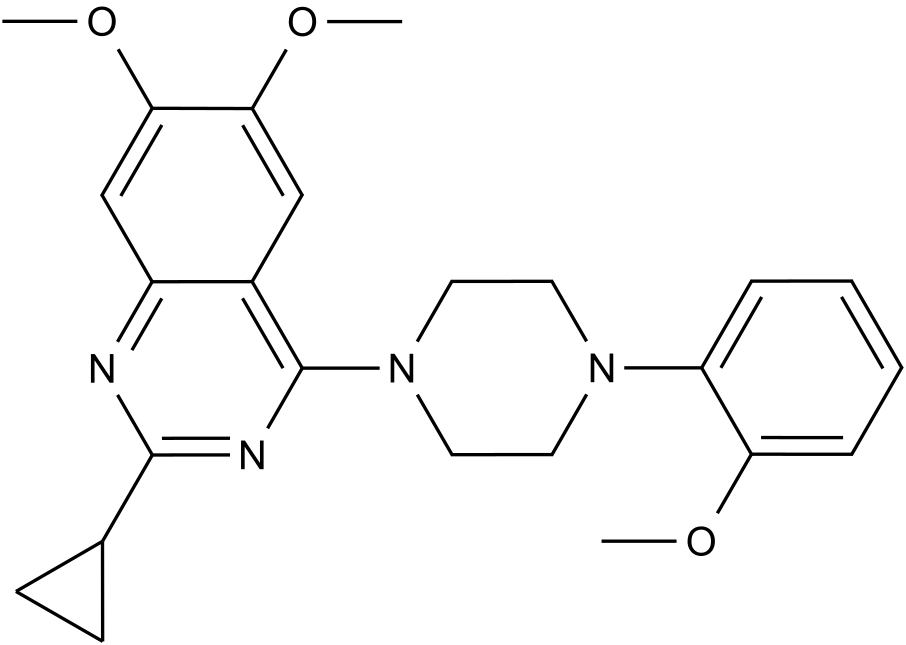
CAS:
1448895-09-7
Purity:
100%
- Soluble in 0.1N HCl(aq) and DMSO
- MF: C24H28N4O3
- MW: 420.5
Description
ML314 is a potent, brain-penetrant, nonpeptidic β-arrestin-biased full agonist of the neurotensin NTR1 receptor. ML314 selectively activates NTR1 (EC50: 2.0 μM) over NTR2 (EC50 >80 µM). Unlike peptide-based NTR1 agonists, ML314 elicits no significant response in a Ca2+ mobilization assay. ML314 is a viable, preclinical lead for methamphetamine abuse treatment. It serves as a crucial chemical probe for studying drug addiction and neurotensin signaling mechanics.
NTR1 pharmacology is relevant to disease-relevant cellular and translational research models; ML314 supports mechanistic studies of NTR1, β-arrestin, central nervous system in biochemical, cellular and disease-model assays.
Key Features
- β-arrestin-biased NTR1 agonist, bypassing traditional (G_{q})-coupled calcium mobilization
- Selectively targets NTR1 without impacting NTR2 and GPR35 receptors
- Readily crosses the blood-brain barrier to target CNS receptors.
- Vital chemical probe for neurotensin signaling
Applications
- NTR1 pharmacology and target-validation studies
- NTR1 pathway and signaling assays
- Disease-relevant cellular and translational model systems
- Receptor signaling, ligand profiling and functional response assays
More Information
| Parent CAS No. | 1448895-09-7 |
|---|---|
| Chemical Name | 2-cyclopropyl-6,7-dimethoxy-4-(4-(2-methoxyphenyl)piperazin-1-yl)quinazoline |
| SMILES | N1=C2C(C=C(OC)C(OC)=C2)=C(N2CCN(C3=CC=CC=C3OC)CC2)N=C1C1CC1 |
| MFCD | N.A. |
| InChi | InChI=1S/C24H28N4O3/c1-29-20-7-5-4-6-19(20)27-10-12-28(13-11-27)24-17-14-21(30-2)22(31-3)15-18(17)25-23(26-24)16-8-9-16/h4-7,14-16H,8-13H2,1-3H3 |
| InChiKey | SWEOAXMICIJCQC-UHFFFAOYSA-N |
| CID | 53245590 |
| Short Description | NTR1 agonist |
ML314
brain-penetrant β-arrestin-biased NTR1 agonist
ML-314
Neurotensin
brain-penetrant β-arrestin-biased NTR1
dopamine
Agonist
Chemical probe
calcium signaling
NTR1 pharmacology
NTR1 signaling assays
receptor signaling and ligand profiling
neuroscience
addiction research
receptor selectivity
signal transduction
chemical biology
receptor pharmacology
GPCR
CNS
BBB
CAS 1448895-09-7
Axon Medchem
Axon 2632
Supplier
Vendor
References
- LS Barak et al. ML314: A Biased Neurotensin Receptor Ligand for Methamphetamine Abuse. ACS Chem Biol. 2016 Jul 15;11(7):1880-90.
- S Peddibhotla et al. Discovery of ML314, a Brain Penetrant Non-Peptidic β-Arrestin Biased Agonist of the Neurotensin NTR1 Receptor. ACS Med Chem Lett. 2013 Jul 20;4(9):846-851.
Other Categories



Get a Quote for
Loading...