
Bulk Inquiry
SR 142948A
Axon 1255
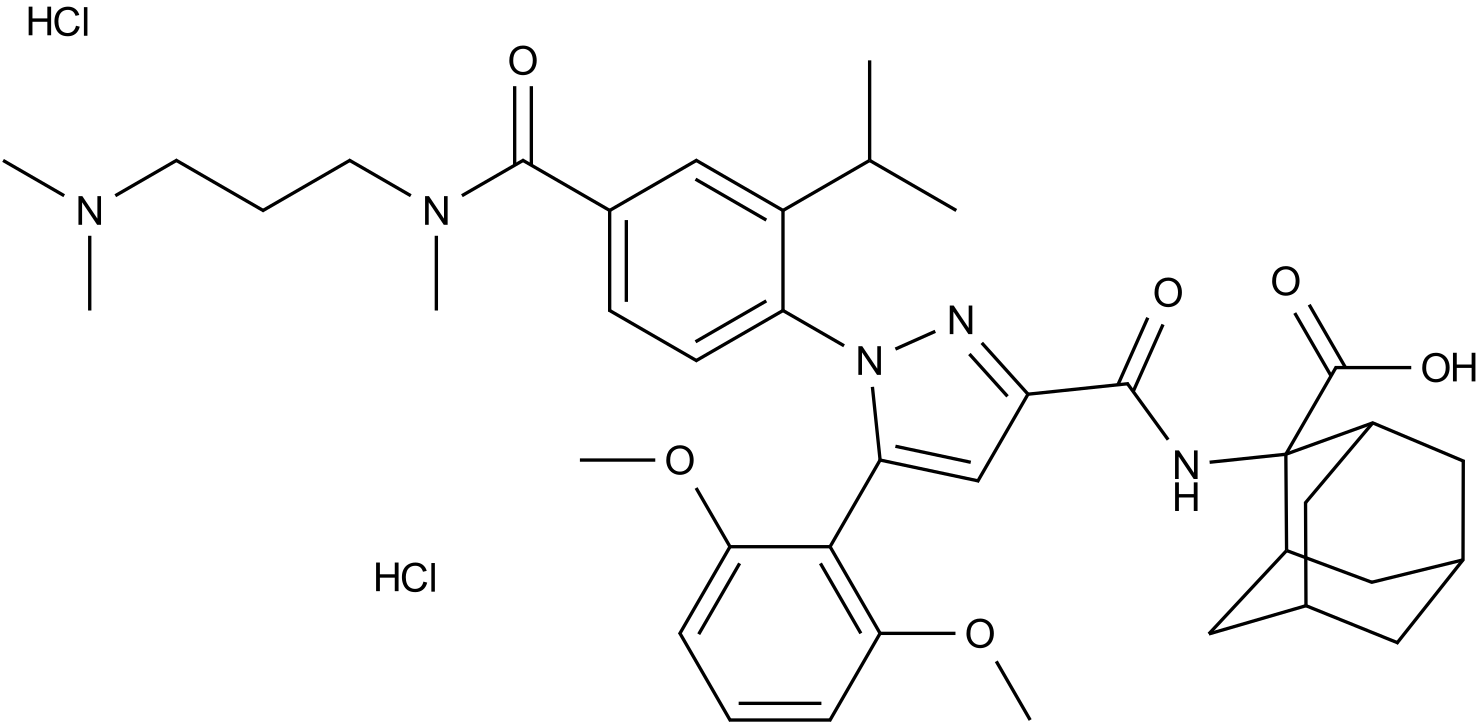
- Parent CAS: 184162-64-9
Purity:
98%
- Soluble in water
- MF: C39H51N5O6
- MW: 685.85
Description
SR 142948A is an orally active and potent neurotensin receptor antagonist used to block neurotensin (NT) signaling. SR 142948A has very high binding affinities for both NTR1 and NTR2 neurotensin receptors with IC50 values in the range from 0.32 to 3.96 nM.
Neurotensin receptors regulate dopaminergic neurotransmission, pain processing, gastrointestinal function and endocrine responses. SR 142948A is useful for studying neurotensin receptor biology in CNS and peripheral models.
Key Features
- Orally active neurotensin receptor antagonist
- Blocks neurotensin GPCR signaling
- Useful for CNS and gastrointestinal neuropeptide research
- Relevant to dopaminergic modulation and pain pathway studies
Applications
- Neurotensin receptor pharmacology
- Neuropeptide signaling assays
- Dopamine-neurotensin interaction studies
- Gastrointestinal and pain model research
More Information
| Parent CAS No. | 184162-64-9 |
|---|---|
| Chemical Name | 2-[(5-(2,6-Dimethoxy-phenyl)-1-{4-[(3-dimethylamino-propyl)-methyl-carbamoyl]-2-isopropyl-phenyl}-1H-pyrazole-3-carbonyl)-amino]-adamantane-2-carboxylic acid dihydrochloride |
| SMILES | C1=C(C(C)C)C(N2N=C(C(=O)NC3(C(=O)O)C4CC5CC(C4)CC3C5)C=C2C2=C(OC)C=CC=C2OC)=CC=C1C(=O)N(C)CCCN(C)C.Cl.Cl |
| MFCD | MFCD03106493 |
| InChi | InChI=1S/C39H51N5O6.2ClH/c1-23(2)29-21-26(37(46)43(5)15-9-14-42(3)4)12-13-31(29)44-32(35-33(49-6)10-8-11-34(35)50-7)22-30(41-44)36(45)40-39(38(47)48)27-17-24-16-25(19-27)20-28(39)18-24;;/h8,10-13,21-25,27-28H,9,14-20H2,1-7H3,(H,40,45)(H,47,48);2*1H |
| InChiKey | AQJKZKHTPLUIAD-UHFFFAOYSA-N |
| CID | 5311451 |
| Short Description | NT antagonist |
SR 142948A
orally active neurotensin receptor antagonist
SR142948A
SR-142948A
Neurotensin
neurotensin receptor
Antagonist
GPCR signaling
dopamine signaling
Neurotensin receptor pharmacology
Neuropeptide signaling assays
Dopamine-neurotensin interaction studies
Gastrointestinal and pain model research
pain research
GPCR pharmacology
signal transduction
receptor pharmacology
CNS
GPCR
CAS 184162-64-9
Axon Medchem
Axon 1255
Supplier
Vendor
References
- D Gully et al. Biochemical and pharmacological activities of SR 142948A, a new potent neurotensin receptor antagonist. J. Pharmacol. Exp. Ther. 1997, 280, 802.
- SM Reynolds et al. Neurotensin antagonist acutely and robustly attenuates locomotion that accompanies stimulation of a neurotensin-containing pathway from rostrobasal forebrain to the ventral tegmental area. Eur. J. Neurosci. 2006, 24(1), 188-196.
Other Categories

Get a Quote for
Loading...