
Bulk Inquiry
WYE 672
Axon 1991
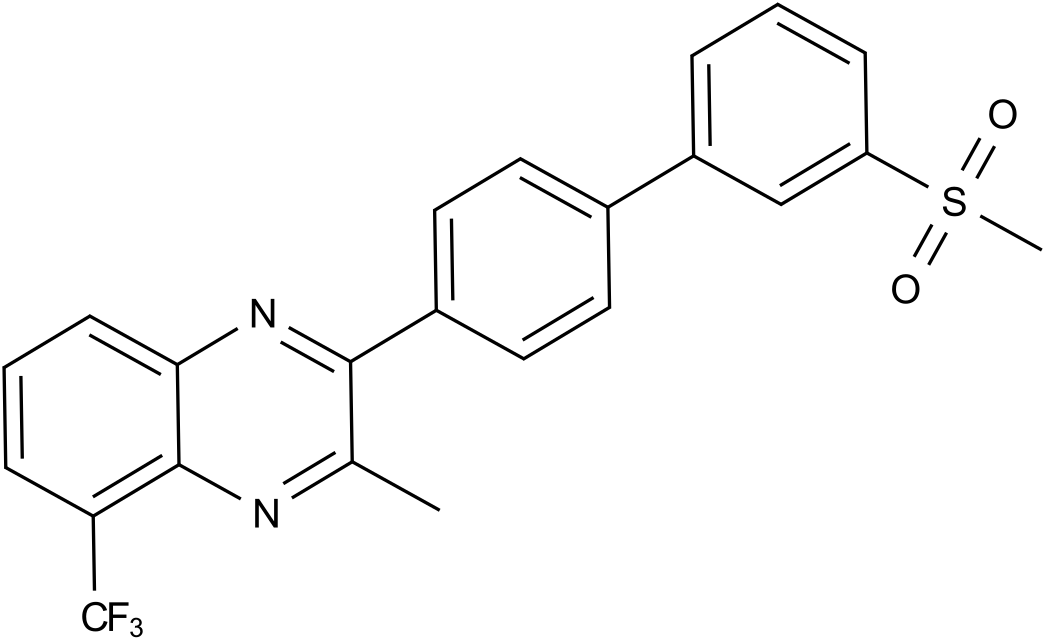
CAS:
1221265-37-7
Purity:
99%
- Soluble in DMSO
- MF: C23H17F3N2O2S
- MW: 442.45
Description
WYE 672 is a tissue-selective liver X receptor (LXR) agonist with reported IC50 activity of 53 nM for LXRβ and substantially weaker binding to LXRα. It provides pharmacological preference for LXRβ-associated signaling.
LXR receptors regulate cholesterol efflux, lipid metabolism, inflammatory gene expression and macrophage biology. WYE 672 is useful for studying LXRβ-selective nuclear receptor modulation in metabolic and inflammatory models.
Key Features
- LXRβ-preferring agonist
- Reported IC50: 53 nM for LXRβ
- Tissue-selective LXR pharmacology
- Relevant to cholesterol and lipid homeostasis research
Applications
- LXR reporter assays
- Cholesterol efflux studies
- Macrophage lipid metabolism research
- Nuclear receptor modulator profiling
More Information
| Parent CAS No. | 1221265-37-7 |
|---|---|
| Chemical Name | 3-methyl-2-(3'-(methylsulfonyl)biphenyl-4-yl)-5-(trifluoromethyl)quinoxaline |
| SMILES | N1C2C(=C(C(F)(F)F)C=CC=2)N=C(C)C=1C1=CC=C(C2=CC=CC(S(C)(=O)=O)=C2)C=C1 |
| MFCD | MFCD18206803 |
| InChi | InChI=1S/C23H17F3N2O2S/c1-14-21(28-20-8-4-7-19(22(20)27-14)23(24,25)26)16-11-9-15(10-12-16)17-5-3-6-18(13-17)31(2,29)30/h3-13H,1-2H3 |
| InChiKey | YKGVGRQMFLSEFJ-UHFFFAOYSA-N |
| CID | 46206336 |
| Short Description | LXR agonist |
WYE 672
LXRβ-preferring agonist
WYE672
LXRβ-preferring
Agonist
LXR reporter assays
Cholesterol efflux studies
Macrophage lipid metabolism research
Nuclear receptor modulator profiling
inflammation
macrophage biology
metabolism
lipid metabolism
receptor selectivity
signal transduction
transcriptional regulation
CAS 1221265-37-7
Axon Medchem
Axon 1991
Supplier
Vendor
References
- B Hu et al. Identification of phenylsulfone-substituted quinoxaline (WYE-672) as a tissue selective liver X-receptor (LXR) agonist. J. Med. Chem. 2010, 53(8), 3296-3304.
- T Jakobsson et al. Liver X receptor biology and pharmacology: new pathways, challenges and opportunities. Trends Pharmacol Sci. 2012, 33(7), 394-404.
Other Categories



Get a Quote for
Loading...