
Bulk Inquiry
NS 3694
Axon 1883
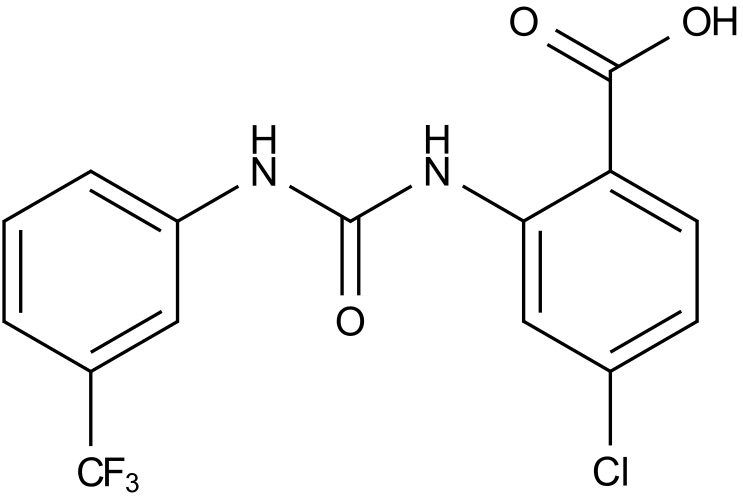
CAS:
426834-38-0
Purity:
99%
- Soluble in 0.1N NaOH(aq) and DMSO
- MF: C15H10ClF3N2O3
- MW: 358.7
Description
NS 3694 is an apoptosis inhibitor that blocks Apaf-1 apoptosome formation and prevents activation of initiator caspase-9.
The Apaf-1 apoptosome is a central activation platform for the intrinsic mitochondrial apoptosis pathway. NS 3694 is useful for studying apoptosome-dependent caspase activation without directly inhibiting caspase enzymatic activity.
Key Features
- Inhibits Apaf-1 apoptosome formation
- Blocks initiator caspase-9 activation
- Does not directly inhibit apoptosome-independent caspase activation
- Useful for intrinsic apoptosis pathway dissection
Applications
- Apoptosome assembly studies
- Intrinsic apoptosis and mitochondrial cell death research
- Caspase-9 activation assays
- Cell survival and apoptosis pathway validation
More Information
| Parent CAS No. | 426834-38-0 |
|---|---|
| Chemical Name | 4-chloro-2-(3-(3-(trifluoromethyl)phenyl)ureido)benzoic acid |
| SMILES | C1(NC(=O)NC2C=C(C(F)(F)F)C=CC=2)C(C(O)=O)=CC=C(Cl)C=1 |
| MFCD | MFCD00249000 |
| InChi | InChI=1S/C15H10ClF3N2O3/c16-9-4-5-11(13(22)23)12(7-9)21-14(24)20-10-3-1-2-8(6-10)15(17,18)19/h1-7H,(H,22,23)(H2,20,21,24) |
| InChiKey | GNCZTZCPXFDPLI-UHFFFAOYSA-N |
| CID | 10109069 |
| Short Description | Inhibitor of apoptosis |
NS 3694
Apaf-1 apoptosome formation inhibitor
NS3694
Procaspase-9
CASPASE-9
Apaf-1 apoptosome formation
Inhibitor
Apoptosome assembly studies
Intrinsic apoptosis and mitochondrial cell death research
Caspase-9 activation assays
Cell survival and apoptosis pathway validation
apoptosis
mitochondrial function
enzyme pharmacology
drug discovery
CAS 426834-38-0
Axon Medchem
Axon 1883
Supplier
Vendor
References
- U Lademann et al. Diarylurea compounds inhibit caspase activation by preventing the formation of the active 700-kilodalton apoptosome complex. Mol. Cell Biol. 2003, 23(21), 7829-7837.
- A. Degterev et al. Chemical inhibitor of nonapoptotic cell death with therapeutic potential for ischemic brain injury. Nature Chem. Biol. 2005, 1, 112.
Other Categories
Get a Quote for
Loading...