Bulk Inquiry
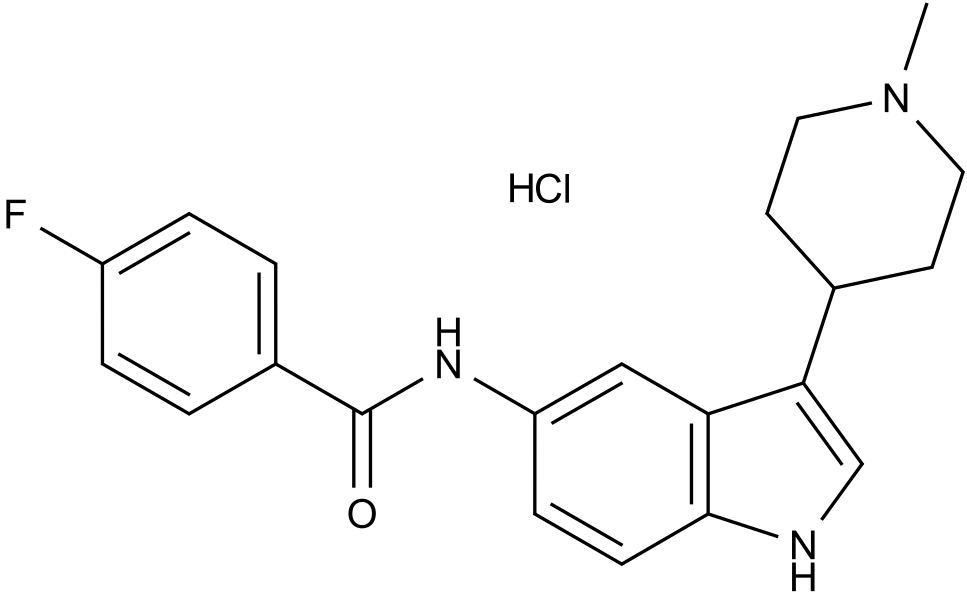
LY 334370 hydrochloride
Axon 1612
- Parent CAS: 182563-08-2
Purity:
99%
- Soluble in water and DMSO
- MF: C21H22FN3O.HCl
- MW: 387.88
Description
LY 334370 hydrochloride is a selective serotonin 5-HT1F receptor agonist with reported Ki value of 1.87 nM.
5-HT1F receptor activation is pharmacologically relevant to migraine mechanisms because it can modulate trigeminal neurotransmission without vasoconstrictive 5-HT1B activity. LY 334370 is useful for studying 5-HT1F-selective agonism and migraine-related CNS pathways.
Key Features
- Selective 5-HT1F receptor agonist
- Reported Ki: 1.87 nM
- Modulates trigeminal nociceptive signaling pathways
- Useful for migraine mechanism research
Applications
- 5-HT1F receptor pharmacology
- Migraine pathway studies
- Trigeminal nociception models
- Serotonin GPCR agonist assays
More Information
| Parent CAS No. | 182563-08-2 |
|---|---|
| Chemical Name | 4-fluoro-N-(3-(1-methylpiperidin-4-yl)-1H-indol-5-yl)benzamide hydrochloride |
| SMILES | N(C1C=CC2NC=C(C3CCN(C)CC3)C=2C=1)C(C1C=CC(F)=CC=1)=O.Cl |
| MFCD | MFCD11519957 |
| InChi | InChI=1S/C21H22FN3O.ClH/c1-25-10-8-14(9-11-25)19-13-23-20-7-6-17(12-18(19)20)24-21(26)15-2-4-16(22)5-3-15;/h2-7,12-14,23H,8-11H2,1H3,(H,24,26);1H |
| InChiKey | DGPDGAPZTPSHBL-UHFFFAOYSA-N |
| CID | 19710026 |
| Short Description | 5-HT1F antagonist |
LY 334370 hydrochloride
5-HT1F receptor agonist
LY334370
5-HT1F
HTR1
HTR1B
5-HT1F receptor
Agonist
GPCR signaling
serotonin signaling
5-HT1F receptor pharmacology
Migraine pathway studies
Trigeminal nociception models
Serotonin GPCR agonist assays
pain research
GPCR pharmacology
receptor selectivity
signal transduction
CNS
GPCR
CAS 182563-08-2
CAS 199673-74-0
Axon Medchem
Axon 1612
Supplier
Vendor
References
- DS Dupuis et al. G-protein activation at 5-HT1A receptors by the 5-HT1F ligand LY-334,370 in guinea-pig brain sections and recombinant cell lines. Br. J. Pharmacol. 1998, 124(2), 283–90.
- S Shepheard et al. Possible antimigraine mechanisms of action of the 5HT1F receptor agonist LY-334,370. Cephalalgia 1999, 19(10), 851-858.